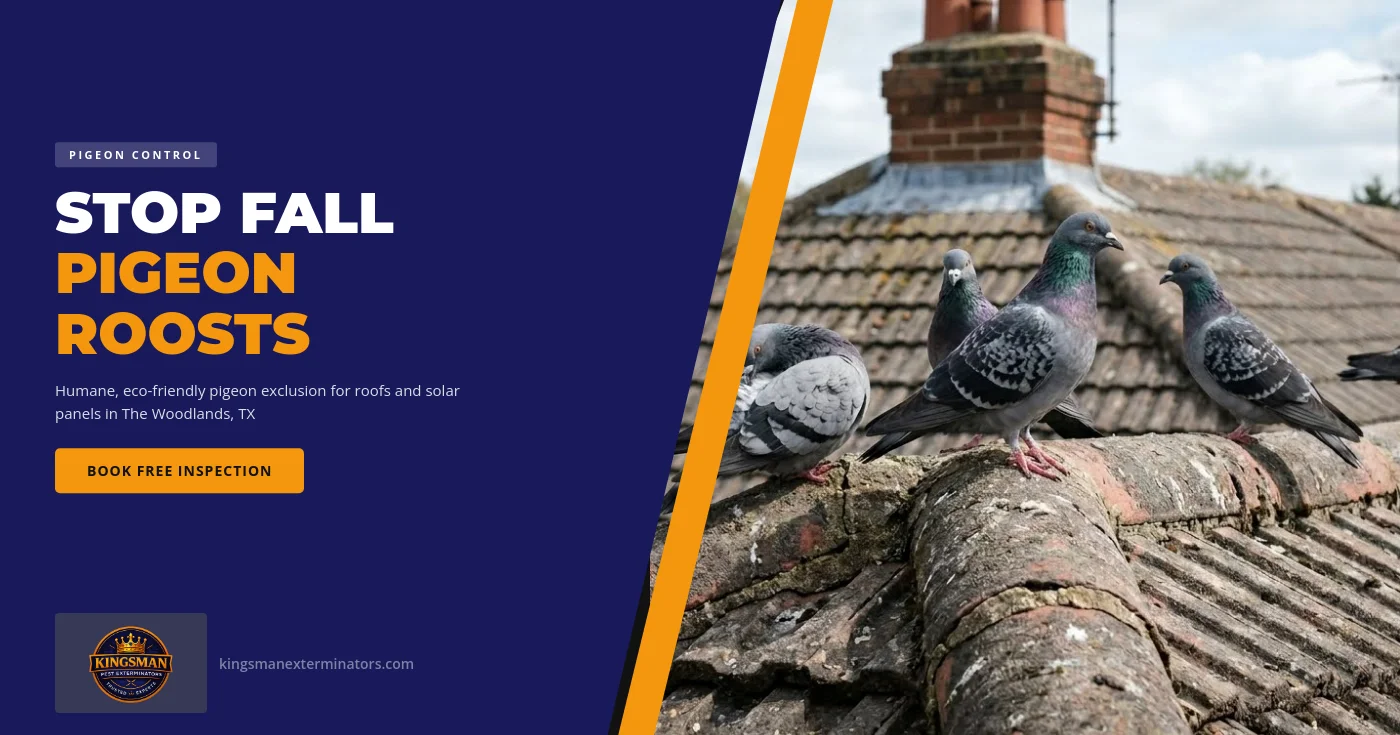
If you’ve noticed pigeons lining your roof ridge, perching on your gutters or disappearing under your solar panels as the evenings cool off, you’re not imagining it. Every October, the first cold fronts push local birds toward sheltered, heat-holding spots. That’s exactly when requests for pigeon control in The Woodlands, TX start climbing.
A few birds on the roof might seem harmless. But pigeons are loyal to the places they roost, and they breed year-round in our mild climate. Their droppings also build up fast on shingles, gutters and panels. What starts as a handful of visitors in fall can become a full nesting colony by spring.
Here at Kingsman Pest Exterminators, we help North Houston homeowners and businesses get ahead of that cycle.
Why Pigeons Move Onto Woodlands Rooftops in October
October usually brings our first real cool-downs. Daytime highs often stay in the 80s, but nights can dip into the 50s and 60s. Pigeons respond by looking for shelter that holds the day’s warmth. Roofs are ideal: shingles and metal absorb sun all afternoon, and the gaps around chimneys, dormers and solar arrays block the wind.
Biology plays a part too. Rock pigeons (Columba livia) originally nested on cliff ledges, and to them a roofline is simply a cliff with better amenities. Neighborhoods tucked into the pines also offer plenty of food.
Site Loyalty and Year-Round Breeding
According to the Cornell Lab of Ornithology, rock pigeons can breed throughout the year where the climate allows. They also tend to return to the same roosting and nesting spots. In practice, birds that settle on your roof in fall may raise several broods there before summer. Each pair typically lays two eggs per clutch, so a small group can multiply quickly.
Fall is also the tail end of hurricane season, which officially runs through November 30. Gutters packed with nest debris and droppings can’t handle heavy rain, so a pigeon problem in October can turn into a water problem during the next storm. That timing is why we consider early fall one of the best windows for pigeon proofing in North Houston.
The Favorite Fall Roosting Spots: Solar Panels, Eaves, Chimneys and Attic Vents
Pigeons aren’t random about where they settle. They want:
- Overhead cover
- A flat or gently sloped surface
- Protection from wind and predators
- A clear flight path in and out
Around homes, a few features check every box.
Under Solar Panels
The space between a rooftop solar array and the shingles is shaded and warm, and hawks can’t easily reach it. It’s one of the most common complaints we hear as rooftop solar spreads across the Houston suburbs.
Nesting material and droppings collect under the panels, and droppings can soil the glass and may reduce output over time. Birds pecking around the array can also damage exposed wiring. Solar panel bird proofing closes off that gap before nests take hold.
Eaves, Soffits and Attic Vents
Gaps where a soffit meets the fascia, damaged gable vents and loose ridge vents give pigeons a path into protected spaces, sometimes all the way into the attic. Once inside, nests can block airflow, and bird mites and other parasites can follow.
Chimneys, Dormers and Ledges
Chimney chases hold warmth. The flat tops of dormers, window ledges and decorative trim act like the cliff shelves pigeons prefer. Dryer and exhaust vents are another target, and nests in those openings can trap lint and heat.
Signs You Have a Pigeon Problem Before Nests Take Hold
Catching pigeons early makes exclusion faster and simpler. Here’s what to watch for on your property this fall:
- Birds lining the roof at dusk. Pigeons returning to the same ridge or ledge every evening are treating it as a roost.
- Cooing or scratching overhead. Sounds from the roofline, attic or behind solar panels often point to nesting.
- White streaks on siding, windows, driveways or panels. Fresh droppings below a ledge mark the exact spot birds are perching.
- Twigs, feathers and debris poking out from under panels, in gutters or around vents.
- Slow-draining gutters and downspouts, especially after a fall rain.
- Tiny crawling mites near windows or attic access points, which can appear after a nest is abandoned.
If you notice two or more of these signs, the birds have likely chosen your home as a regular stop.
The Real Cost of Pigeon Droppings: Roof Damage, Clogged Gutters and Health Risks
Pigeon droppings are more than an eyesore. They’re acidic, and over time they can stain and wear down shingles, metal flashing, paint, stone and concrete. On a roof that bakes in the Texas sun, that buildup can shorten the life of the surfaces it sits on.
Gutters, Vents and Water Damage
Nests and droppings clog gutters and downspouts, which can send water back under shingles or over the fascia during heavy rain.
Attic nests can also invite other pests. The debris and spilled food sometimes attract rats and mice, so we often pair bird work with rodent control when we find signs of both.
Health Concerns
Dried droppings can harbor fungi linked to histoplasmosis and cryptococcosis, and pigeons can carry the bacteria behind psittacosis. The main risk comes from breathing dust when dried droppings are disturbed.
The CDC notes that many people who breathe in the fungus never get sick, but people with weakened immune systems face greater risk. The agency advises against dry-sweeping. Instead, it recommends wetting droppings and using respiratory protection when cleaning large amounts.
If there’s a significant buildup on your roof, in your attic or around your patio, it’s worth letting trained technicians handle it rather than grabbing a broom.
Why DIY Spikes and Plastic Owls Usually Fail
Walk through any hardware store and you’ll find plastic owls, reflective tape, rubber snakes, ultrasonic boxes and strips of spikes. They’re tempting, but most homeowners who try them see the birds back within weeks.
The reason is habituation. Pigeons are smart and persistent. University wildlife damage experts have long noted that scare devices work only briefly, because birds quickly learn that a plastic owl never moves. There’s little evidence that ultrasonic devices deter pigeons, and reflective tape loses its effect as birds get used to it.
Spikes can work, but only when they’re the right type, spaced correctly and fastened along the entire ledge. Gaps, debris left underneath, or spikes glued onto dirty surfaces give pigeons something to build on. DIY spikes also do nothing for the biggest problem area: the open space under solar panels.
There’s also the roof itself to consider. Climbing onto a pitched roof, working around solar wiring or drilling into panel frames can cause damage or put a warranty at risk. The approach that holds up is physical exclusion that removes access entirely, and that’s where professional, humane bird deterrents come in.
How Professional Pigeon Exclusion Works: Solar Panel Screening, Netting and Sealing Entry Points
Our approach is built on one idea: make your property physically unusable for pigeons without harming them. Here at Kingsman Pest Exterminators, we follow a clear process and explain each step so you know what to expect.
- Free inspection. We identify the species, map roosting and nesting spots, and check roofs, vents, eaves and panels for entry points.
- Humane removal and cleanup. We clear nests and debris using wet-cleanup methods that keep dust down. We also make sure no birds are trapped inside before anything is sealed.
- Exclusion installation. We fit the right barrier to each spot.
- Follow-up. We check the work and address any persistent birds.
Solar Panel Screening
We install galvanized or coated wire mesh around the perimeter of the array. It attaches with non-penetrating clips designed for solar panels, so there’s no drilling into panel frames. The mesh keeps birds and debris out while letting air and water pass through. If you’re unsure about your panel warranty, check with your installer. We’re happy to work within their guidelines.
Netting, Spikes and Sealing
Each area gets the barrier that suits it:
- Low-profile bird netting blocks access to eaves, balconies and larger open areas.
- Properly installed spikes or bird slope cover ledges.
- Durable sealing materials close damaged vents, soffit gaps and other openings as part of our pest exclusion service.
Many neighborhoods follow Woodlands Township and village association design standards that expect visible changes to be discreet. We choose low-profile materials that blend in. Some projects may need HOA approval, and we can help you understand what to ask.
Protecting Commercial Storefronts and HOA Common Areas from Pigeons
Pigeons don’t limit themselves to homes. Retail centers, restaurants, office parks and parking structures offer awnings, signs, light fixtures and beams that make perfect roosts, plus plenty of dropped food.
For a business, the stakes are higher. Droppings on sidewalks, patio tables and entryways hurt first impressions and can create slip hazards.
Our commercial pigeon control keeps storefronts clean and customers comfortable without disrupting operations. Common solutions include:
- Netting under canopies, loading docks and parking garage beams
- Low-profile spikes or bird slope on signs, ledges and awnings
- Sealing gaps in rooftop equipment, light fixtures and HVAC housings
- Scheduled checks and maintenance for high-traffic properties
HOA common areas face similar challenges. Pavilions, pool houses, clubhouse eaves and entry monuments attract roosting birds, and droppings around amenities quickly draw resident complaints.
We work with property managers and boards to plan installations that respect community design standards. Our technicians are licensed, insured and background-checked, which gives managers peace of mind when we’re on-site around residents and customers. Whether you need bird control in The Woodlands or pigeon removal across North Houston, we tailor the plan to the property.
Frequently Asked Questions About Pigeon Control in The Woodlands
Is it legal to remove pigeons and nests in Texas?
Feral rock pigeons are non-native and generally aren’t covered by the federal Migratory Bird Treaty Act, so humane exclusion is typically allowed. Local rules can still apply, and lookalikes such as mourning doves are protected. That’s why we confirm the species before any work begins.
Will solar panel mesh void my warranty?
We use non-penetrating clips that attach without drilling into panel frames, which is the approach many installers prefer. Warranties vary, so we recommend checking your manufacturer’s terms, and we’re glad to review them with you.
When is the best time for pigeon proofing in The Woodlands?
Early fall is ideal. Excluding birds before winter keeps them from claiming your roof as a long-term nesting site. Pigeons breed year-round here, so waiting usually means more nests to deal with.
Will the pigeons come back after exclusion?
They may try, because they remember good roosts. With access blocked, they eventually move on. Our work is backed by our 100% Satisfaction Guarantee, with free re-treatments if issues come up.
Book Pigeon Control in The Woodlands, TX Before Winter Nesting Begins
Pigeons that settle on your roof this fall won’t leave on their own, and every week of droppings adds to the damage. Here at Kingsman Pest Exterminators, we’re locally owned and operated. Since 2023, we’ve served homeowners and businesses across The Woodlands, Spring, Conroe, Shenandoah, Oak Ridge North, Tomball, Magnolia and the rest of North Houston. Our licensed technicians use eco-friendly, pet-friendly methods backed by guaranteed results, with same-day or next-day service available.
Ready for trusted pigeon control The Woodlands TX homeowners can count on? Schedule your free inspection and let us keep your roof, panels and gutters bird-free all season long.
How Can We Keep Pigeons Off Our Roof and Solar Panels This Fall?
When cooler nights arrive, pigeons look for warm, sheltered spots, and roofs, solar arrays, eaves and attic vents top their list. At Kingsman Pest Exterminators, we stop them with humane, eco-friendly exclusion that removes access instead of just scaring birds for a few weeks.
Our pigeon control service includes:
- A free inspection to identify the species, map roosting spots and find every entry point
- Humane nest removal and cleanup using wet methods that keep dust from dried droppings down
- Solar panel screening with coated wire mesh and non-penetrating clips, so there’s no drilling into panel frames
- Netting, spikes, bird slope and sealing for eaves, ledges, chimneys and vents
- Low-profile materials chosen to suit HOA design standards
We also protect commercial storefronts, parking structures and HOA common areas, where droppings can hurt first impressions. Our licensed, insured and background-checked technicians explain every step, and our work is backed by our 100% Satisfaction Guarantee with free re-treatments.
Early fall is one of the best times to act. Pigeons breed year-round in our mild climate, so blocking access now keeps them from settling in for winter. To learn why birds roost on rooftops as temperatures drop and how exclusion works, read our full guide to fall pigeon control.