
If your lawn in Oak Ridge North suddenly sprouted a crop of fluffy dirt piles after the last rain, you’re not imagining it. Fire ants are busy this time of year, which makes fall fire ant treatment one of the smartest moves a North Houston homeowner can make before winter.
Here at Kingsman Pest Exterminators, we hear the same story every fall. A child or dog gets stung in the backyard, a mound appears beside the driveway, and a store-bought product knocks it down for a week before a new one pops up a few feet away. That cycle is frustrating, but it’s predictable, and the right timing and method can break it.
In this post, we’ll cover why mounds rebuild after fall rains, why early-to-mid October is your best window for a fire ant bait treatment, how baits compare with mound drenches, how we protect kids, pets and lawns, what happens when ants move indoors, and what a professional fall fire ant treatment looks like.
Why Fire Ant Mounds Pop Up After Fall Rains in Oak Ridge North
Most homeowners notice the same pattern: a dry spell, a good soaking rain, and then a fresh wave of fire ant mounds in yard spaces that looked clean a week earlier. We see it across the open lawns, garden beds and sidewalk edges common in Oak Ridge North neighborhoods.
We can’t point to a single study that explains the timing, but the practical explanation is simple. Wet soil is easier for workers to move, and colonies often push soil up to rebuild or reshape mounds after water saturates their tunnels. What you see on the surface is only a small piece of what’s happening below.
That point matters more than most people realize. According to the Harris County office of Texas A&M AgriLife Extension, most local mounds have multiple queens and may be spread over larger areas than we actually see. The mound by your mailbox may be connected to tunnels running under the lawn, the flower bed and the fence line.
That’s why treating one visible mound so often fails. Hit the top with a product and the colony simply shifts its activity, often surfacing as a “new” mound days later. The fall rebuild is actually useful information: it shows where colonies are active, how widespread the problem is, and that ants are moving and feeding—exactly the conditions you want before treating.
Why October Is the Ideal Window to Treat Fire Ants in North Houston
Timing is the biggest factor in whether bait works. Foraging workers have to pick it up and carry it home, so it only works when ants are actively out looking for food.
What Texas A&M AgriLife Recommends
AgriLife recommends treating the whole yard rather than chasing single mounds. One suggested approach is broadcasting bait over the entire yard, usually between late August and mid-October, then treating problem mounds individually. Mid-October is the end of that window, not the middle, which is why we encourage homeowners to schedule in early-to-mid October.
AgriLife’s Two-Step Method guide also notes that fall applications work well to reduce fire ant numbers the following spring, and that during winter fire ants forage little and rarely pick up baits. A fall fire ant treatment is essentially a head start on spring: fewer colonies come through winter strong enough to explode in March and April.
Soil Temperature and the Quick Foraging Test
Fire ants forage when the soil surface is between 70 and 90 degrees F. In a typical October around here, cooler nights and mild afternoons tend to keep soil in that range much of the time, though conditions vary year to year and even week to week.
If you’re unsure, AgriLife suggests a simple test: place a little bait or food, like a piece of hot dog or a potato chip, next to a mound. If ants start carrying it off within 30 minutes, it’s a good time to treat. For anyone asking about the best time to treat fire ants in Texas, that test is as reliable as any calendar.
Fire Ant Baits vs. Mound Drenches: Which Fall Treatment Actually Works
Walk down any garden aisle and you’ll find two main product types: baits and mound drenches, plus granules and dusts. They work very differently.
How Baits Work
A bait is a food plus an insecticide. Workers carry it into the colony and share it until it reaches the queens. AgriLife points out that less pesticide is needed with baits because this delivery is so efficient. Baits also reach nests you can’t see, since foragers from hidden colonies find the granules too.
Baits work best scattered lightly over the whole yard, and AgriLife lists a typical rate of 1 to 1½ pounds per acre for most products. That’s far less than many people expect, so always follow the label exactly.
Where Mound Drenches Fit
Drenches act faster on a single mound, which makes them useful for a problem spot beside a patio, play set or doorway. But they only reach the colony you pour them on, and with multi-queen colonies spread across the yard, a drench alone rarely delivers lasting control.
The answer isn’t either/or. The Two-Step Method pairs a yard-wide broadcast bait with targeted treatment of problem mounds, and it works best when followed yearly. One practical tip—always confirm it against your product’s label: apply bait when the grass is dry and no rain is expected for about a day, so the granules stay attractive to foragers.
Protecting Kids, Pets, and Lawns During Fire Ant Treatment
Fire ants are often the biggest threat in the yard. Their stings are painful, and toddlers and curious dogs tend to find mounds before adults do. Still, it’s natural to want to know what’s going on your lawn.
The good news is that baiting uses very little product. AgriLife’s Two-Step guide notes that, when properly applied, this method causes little risk to people, pets or the environment. “Properly applied” is where experience matters.
Here at Kingsman Pest Exterminators, we rely on pet-friendly, low-toxicity products and eco-friendly practices on every yard. Before we leave, we’ll tell you:
- How long to keep kids and pets off treated areas, based on the product label
- When it’s fine to mow or water again
- Which spots received targeted mound treatment so you can keep an eye on them
A few habits help too. Bring in pet food bowls left outside, avoid disturbing mounds for a few days so foragers keep carrying bait home, and tell us about vegetable gardens, pools or ponds so we can plan around them.
When Fire Ants Head Indoors as Temperatures Drop
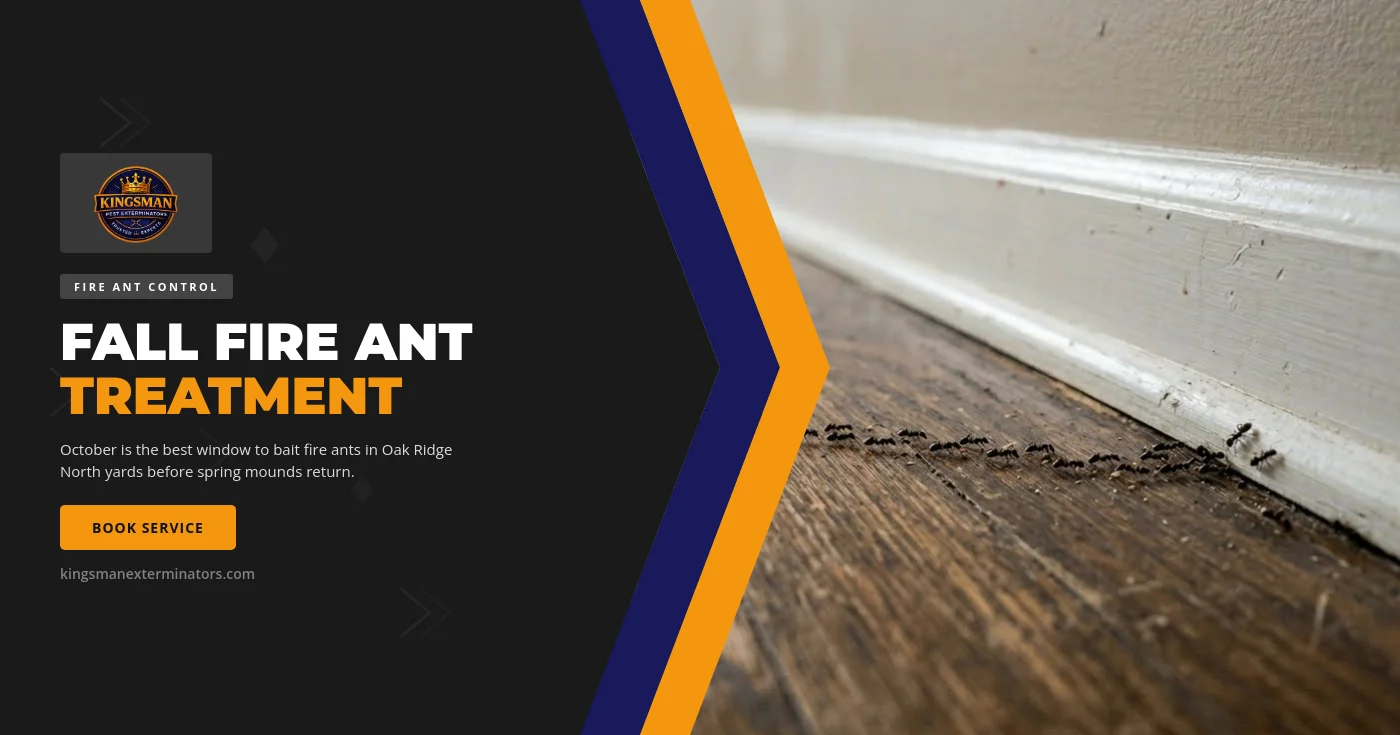
Fire ants are mainly outdoor pests, but they don’t always stay that way. As weather shifts, colonies near the foundation may send foragers inside looking for food, moisture or steadier temperatures, and heavy rain can push them toward higher, drier ground. There’s no single rule for when this happens; it varies by home and season.
Common entry points include:
- Cracks in the slab or foundation
- Gaps around plumbing and utility lines
- Weep holes and gaps under doors
- Mulch and soil piled against siding
If you’re spotting fire ants in the kitchen, bathroom or near outlets, yard treatment alone may not be enough. Sealing entry points through our pest exclusion service, combined with yard baiting, addresses both the source and the doorway. Avoid spraying store-bought insecticide along indoor trails, since that can scatter workers without reaching the colony outside. Seeing more than ants? Our full range of pest control services also covers cockroaches, spiders, rodents and more.
What to Expect From a Professional Fall Fire Ant Treatment
Hiring a fire ant exterminator isn’t just about someone else spreading granules. It’s about getting timing, product choice and coverage right the first time. Here’s how our visits generally work:
- Inspection. We walk the property, map active mounds and look for foraging trails, moisture issues and spots where ants may be getting inside.
- Yard-wide bait. We broadcast bait at the label rate across lawn and landscape while ants are actively foraging.
- Targeted mound treatment. Mounds near play areas, patios and doorways get individual attention.
- Clear instructions. You’ll know when kids and pets can return, when to water and what to watch for.
- Follow-up. If activity hangs on, our 100% Satisfaction Guarantee includes free re-treatments.
Here at Kingsman Pest Exterminators, our licensed, insured and background-checked technicians offer same-day or next-day service availability, so a stinging emergency doesn’t have to wait. AgriLife also notes that a pest management professional can broadcast a granular fipronil product once a year, preferably in early spring, as another yard-wide option. We’re happy to talk through which approach fits your property.
One realistic expectation: no method removes every fire ant from an area for good. Queens fly in from neighboring properties and new colonies form. The goal of ant control in North Houston is fewer mounds, fewer stings and a yard you can actually use, maintained with a yearly plan.
Frequently Asked Questions About Fall Fire Ant Treatment in Oak Ridge North
Is fall or spring better for fire ant treatment?
Both can work. Fall applications are especially useful because they reduce fire ant numbers the following spring, and many homeowners pair a fall bait with a spring follow-up. For yards with heavy pressure, a yearly plan gives the most consistent results.
Is it too late for fire ant control in Oak Ridge North, TX, in November?
Not always. If warm spells keep soil in the 70–90°F range and ants pass the food test, bait can still be picked up. As weather cools, though, foraging slows and results get less predictable, which is why we push for early-to-mid October.
Why do mounds keep moving after I treat them?
Treating only the top of a mound often misses multiple queens and connected tunnels, so the colony simply relocates. A yard-wide bait reaches the whole colony, including mounds you can’t see.
How long do fire ant baits take to work?
It depends on the product. Some act within days, while others work more gradually over several weeks as the colony shares the bait. Check the label, or ask us what timeline to expect from the product we used.
Book Your Fall Fire Ant Treatment With a Trusted Local Team
October offers a short but powerful window: ants are foraging, mounds are easy to spot after fall rains, and every colony you knock out now is one less waiting for spring. A well-timed fall fire ant treatment is the easiest way to head into winter with a yard your family can enjoy.
Kingsman Pest Exterminators has been locally owned and operated since 2023, serving Oak Ridge North, The Woodlands, Spring, Conroe, Shenandoah, Tomball, Magnolia and communities across North Houston with guaranteed, eco-friendly results. Ready to get ahead of next spring’s mounds? Contact us today to schedule your fall fire ant treatment.
When Is the Best Time to Treat Fire Ants in Oak Ridge North?
If fresh mounds are popping up across your lawn after the fall rains, we have good news: early-to-mid October is one of the best windows of the year to get fire ants under control. Colonies are foraging hard before winter, which means the bait we apply gets carried straight back to the queens. Wait until the cold sets in and ants barely forage, leaving bait untouched.
Here at Kingsman Pest Exterminators, we follow the proven two-step approach recommended by Texas A&M AgriLife:
- Yard-wide bait applied lightly at the label rate to reach colonies you can see and the ones you can’t
- Targeted mound treatment for problem spots near patios, play areas and doorways
- Pet-friendly, low-toxicity products with clear instructions on when kids and pets can return
- Free re-treatments backed by our 100% Satisfaction Guarantee
Our licensed, insured and background-checked technicians offer same-day or next-day service availability, and we’re locally owned and operated, serving neighborhoods throughout North Houston. A well-timed fall visit means fewer mounds and fewer stings when spring arrives.
We won’t promise to remove every fire ant from the neighborhood forever—no one honestly can—but we will give you a yard your family can actually use.
Want the full breakdown on timing, baits versus drenches, and what happens when ants move indoors? Read our complete guide: Fall Fire Ant Treatment in Oak Ridge North, TX: Why October Is the Best Time to Knock Out Mounds Before Spring.