
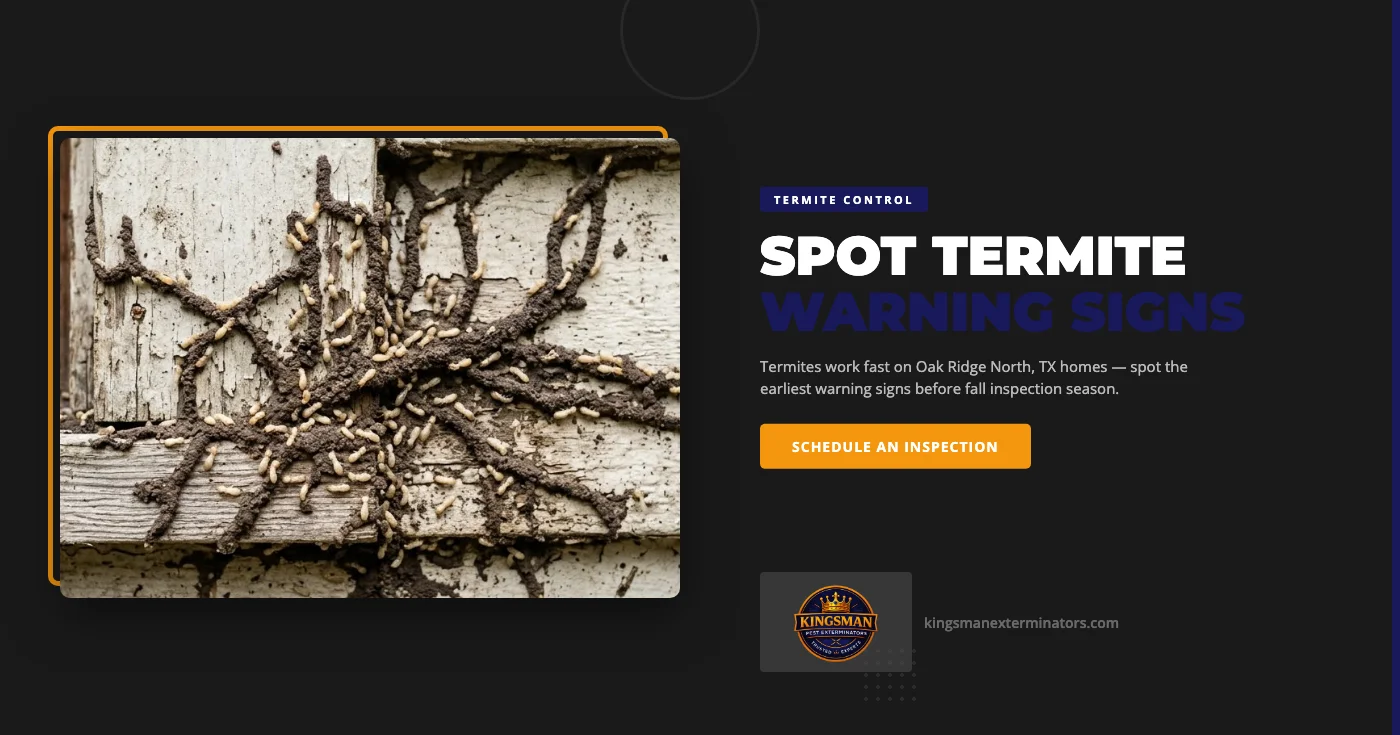
Late summer in Oak Ridge North sits at the peak of subterranean termite pressure for southeast Texas — and by the time most homeowners notice a mud tube on a foundation wall or a joist that gives way under a screwdriver, workers have often been feeding inside the structure for a year or longer. The infestation that could be contained with a targeted treatment in September routinely becomes structural repair by next spring.
As the local team providing termite treatment in Oak Ridge North, TX, we walk homeowners through their first inspection every week during late summer and fall. Below, we cover why homes in this part of Montgomery County are exposed heading into fall, the early warning signs our technicians look for, how to inspect your own property, the most vulnerable areas, and how our team protects Oak Ridge North homes.
Why Oak Ridge North, TX Homes Are at Risk for Termite Activity in Late Summer
Oak Ridge North sits on top of one of the most termite-favorable microenvironments in Texas. Heavy clay-loam soils, a shallow water table that keeps the ground moist year-round, and the mature tree canopy typical of Montgomery County subdivisions give subterranean termites the exact conditions they need to establish long-lived colonies.
The two dominant species here are the eastern subterranean termite (Reticulitermes flavipes) and the more aggressive Formosan subterranean termite (Coptotermes formosanus). According to Texas A&M AgriLife Extension, these are the two most economically important termite species in the state, and a single Formosan colony can consume roughly one foot of 2×4 lumber every day.
Late summer through early fall is the peak-pressure window here. Weeks of Gulf Coast humidity keep soil moisture at its highest annual point, letting underground colonies stay active. Mature workers that spent summer expanding foraging territory now reach suburban structures at the edge of their range. And residual September soil warmth pushes worker activity into higher gear as colonies provision winter stores.
Neighborhoods around Oak Ridge North — Robinson Road, Woodson Road, and the Robinwood corridor — share a housing profile termites take advantage of consistently: slab-on-grade construction, mature landscaping, proximity to greenbelts and drainage swales, and established trees whose stumps create underground reservoirs of decomposing wood. Those features help a young colony survive its first three years — the window before damage becomes visible inside the home.
Common Early Warning Signs of Termite Damage in Texas Homes
Early termite damage is more subtle than most homeowners expect. The animals feed hidden inside wood, travel through soil rather than across visible surfaces, and seal tunnels behind them. Our technicians look for the following:
- Pencil-sized mud tubes on foundation walls, pier posts, and crawl-space piers. The clearest exterior sign of an active subterranean colony — the tunnels workers use to travel from soil to wood.
- Discarded wings on windowsills, garage floors, and around exterior lighting. Even a small pile of translucent, equally-sized wings usually means a colony nearby.
- Wood that sounds hollow when tapped. A door frame, baseboard, or joist that gives a papery thud has been hollowed from the inside.
- Blistered or rippled paint on trim, casings, and window sills. Trapped moisture and lost structure beneath the paint show through as bubbling.
- Buckling floors, sagging spots, and sticking doors or windows that were previously smooth. As termites consume subfloor material, the surface flexes.
- Faint clicking inside walls at night. Soldiers bang their heads against tunnel walls when disturbed — audible in a quiet room.
- Longitudinal galleries following the wood grain. When damaged wood is opened, subterranean tunnels run with the grain — a distinctive pattern separating them from other wood-destroying pests.
One sign is worth investigating. Two together — a mud tube plus a sticking side door — is a strong indicator of an active infestation already consuming structural wood.
How to Inspect Your Oak Ridge North Property for Termite Activity
A homeowner inspection is not a substitute for a licensed professional, but it catches warning signs early enough to save real money. Set aside an hour on a dry weekend, grab a flashlight and screwdriver, and work through the property in this order.
Start at the perimeter. Walk the entire foundation line and look for mud tubes running vertically up the slab, brick veneer, or pier bases. Pay closest attention to shaded areas — the north-facing side of the house, under HVAC condensers, and anywhere mulch contacts siding.
Check every soil-to-wood contact point. Fence-post bases touching siding, wooden deck posts sunk into soil, and stair stringers resting on grade are constant entry ramps in Montgomery County. Any wood in ground contact should be probed with the screwdriver — if the tool sinks in or the wood sounds hollow, the interior has been consumed.
Move through the garage and utility rooms. Check the sole plate where framing meets slab, especially near the water heater, washing machine drain pan, and any plumbing penetration.
Work the crawl space or pier-and-beam area. Follow every joist and beam with the flashlight, look for mud tubes hanging from subfloor to soil, and probe suspect wood. According to UC IPM's termite reference, subterranean feeding follows the wood grain, leaving longitudinal galleries distinctive from other wood-destroying pests.
Finish in the attic and along interior walls backing onto an exterior wall. Look for pinhole exit points on baseboards and casings, and press on trim to feel for softness under the paint. Note anything that seems off — a documented starting point makes any professional follow-up more productive.
The Areas of Your Home Most Vulnerable to Termite Damage
Across Oak Ridge North and surrounding Montgomery County subdivisions, the same handful of locations show up on nearly every active-termite inspection.
- Foundation-to-siding transitions. The four-to-six inch gap that should exist between grade and siding is often lost as landscaping settles and mulch accumulates. Once that gap disappears, termites travel from soil to wood without building a visible tube.
- Bath traps and plumbing penetrations. Where drain lines exit the slab beneath tubs and showers is a chronic entry route. Small concrete gaps plus a minor leak create ideal termite conditions.
- Expansion joints and slab cracks. Even hairline separations are large enough for subterranean termites. Older Montgomery County homes with settlement cracks often have multiple foraging routes established before visible damage appears.
- Attached porches, patios, and steps with earth fill. Porch slabs poured over compacted soil give termites an ideal launching point — soil sits against house framing while the slab conceals what happens underneath.
- Wooden fencing tied into the house. A fence running from property line to siding creates an unbroken wood bridge for foraging termites.
- Garage door frames and thresholds. Wood plates behind garage door tracks sit low to the slab and often stay damp. On several homes along the Robinson Road corridor, this was the first point of structural damage.
- Wood mulch beds and landscape timbers touching siding. Any decorative wood within a few inches of the wall leads directly to structural wood — rock or rubber mulch is a better choice for the two feet closest to the foundation.
What Happens If You Ignore Early Termite Signs in Montgomery County
The temptation to wait — to hope the mud tube was a one-time thing, or that the hollow baseboard is just old paint — is what makes termite damage so expensive here. Southeast Texas is one of the most active termite-pressure zones in the country, and colonies do not slow down.
Damage timelines. In the first 12 to 18 months, damage stays hidden inside wall cavities, subfloors, and joists. Once the colony matures at three to five years, damage surfaces in visible finishes — by then, structural wood has been eaten from the inside for years.
Financial exposure. Texas A&M AgriLife Extension estimates subterranean termites cause roughly $500 million in property damage across the state each year, and the probability of a home suffering some termite damage within 25 years is very high without protection. Most homeowners insurance policies exclude termite damage.
Repair scope escalates fast. A first-year infestation that could have been contained with a spot treatment often becomes a full-perimeter liquid barrier plus insulation and load-bearing wood replacement two years later — a project measured in tens of thousands of dollars.
Resale complications. Any home listed for sale in Montgomery County is subject to a Wood Destroying Insect inspection at closing. Active termite activity or past unresolved damage almost always requires remediation before a lender will finance the buyer.
How Kingsman Pest Exterminators Protects Oak Ridge North Homes from Termites
Termite control done well is a multi-year commitment, not a one-time spray. Our approach to the termite damage Oak Ridge North TX homeowners face combines a thorough inspection, a treatment plan built for Gulf Coast soil, and ongoing monitoring. On a first visit, our licensed, insured, background-checked technicians:
- Complete a full property inspection. We walk the foundation line, check every soil-to-wood contact, probe suspect wood, and inspect crawl spaces, pier bases, the attic, and interior wall lines.
- Identify the species. Eastern subterranean and Formosan termites call for different strategies. We confirm the species before recommending a plan.
- Recommend a treatment matched to the property. Depending on construction, soil conditions, and infestation scope, the plan may be a liquid soil termiticide barrier, an in-ground monitoring and baiting system, a targeted spot treatment, or a combination.
- Apply the treatment. Our team uses proven, professional-grade termiticides at label rates. For new construction and major renovations, we also install pre-construction termite treatment that protects the slab before the foundation is poured — the single most cost-effective termite protection available.
- Schedule follow-up monitoring to confirm the barrier is holding and catch missed foraging routes early.
- Provide a written service report documenting what was found and treated.
We are locally owned, based nearby in The Woodlands, and every technician is licensed, insured, and background-checked. Our approach favors eco-friendly, low-toxicity methods wherever the infestation allows — mechanical intervention and physical exclusion carry as much of the work as possible, so treatment products stay focused where they are needed and out of your living space. Every service is backed by our 100% Satisfaction Guarantee with free re-treatments.
Frequently Asked Questions About Termite Damage in Oak Ridge North, TX
How often should I have my Oak Ridge North home inspected for termites?
An annual professional termite inspection is right for most homes in Montgomery County. If your home is older than 15 years, has had prior termite activity, or sits on a lot with heavy tree canopy, a twice-yearly cycle fits the pressure level here.
What's the difference between subterranean and Formosan termites?
Both live in underground colonies and enter homes through mud tubes, but Formosan colonies can contain millions of workers and consume wood significantly faster than the native eastern subterranean species. Treatment strategy differs for each.
Are your termite treatments gentle around pets and family?
Yes. We choose professional-grade termite products with low mammalian toxicity, applied at label rates and focused on soil around the foundation rather than living spaces. Bait systems, when used, are enclosed in tamper-resistant stations inaccessible to pets and kids.
How long does a termite treatment last?
A properly installed liquid termiticide barrier typically provides five to ten years of protection. In-ground baiting systems run on monitoring cycles and can protect a home indefinitely as long as annual service is maintained.
Protect Your Oak Ridge North Home Before Fall Brings More Termite Activity
If you have spotted a mud tube on your foundation, a wing pile on a windowsill, or wood that sounds hollow under a screwdriver, do not wait. Early treatment is measured in a service visit or two; late treatment is measured in structural repair. Our Kingsman technicians know where subterranean and Formosan termites establish themselves in Oak Ridge North homes and can typically inspect and quote a plan within one business day. Reach out for trusted, eco-friendly termite treatment in Oak Ridge North, TX and greater Montgomery County, backed by our 100% Satisfaction Guarantee with free re-treatments.