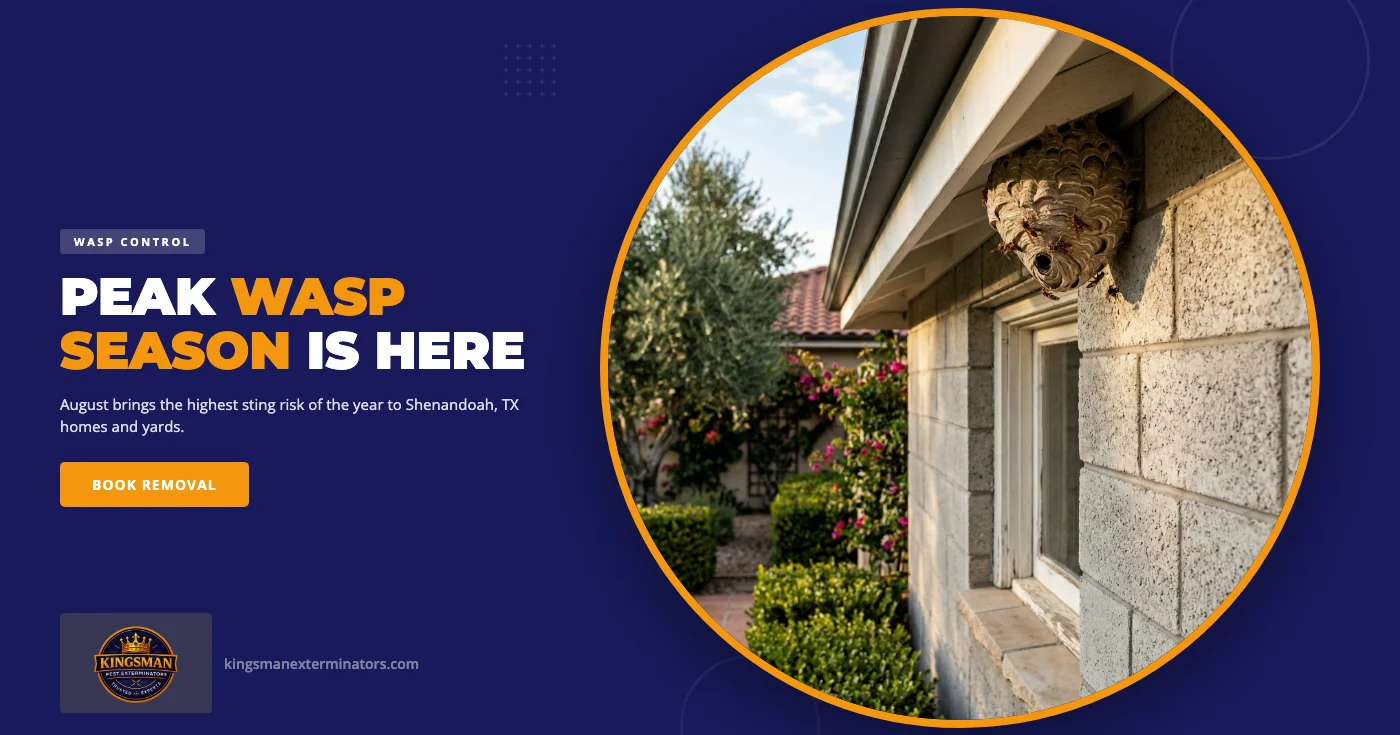
By late August in Shenandoah, TX, the paper wasp comb tucked under a soffit back in April is a fully staffed colony with dozens of defenders — and the yellow jacket ground nest no one noticed in May now holds thousands of workers along an irrigation line. Nests are at their largest, workers at their most defensive, and the sting risk on your property is the highest it will be all year.
As the local team that handles wasp control Shenandoah TX homeowners rely on, we walk properties across Montgomery County every week during peak season. Below: how nests reach peak size by August, which species are active here, why late-summer wasps turn aggressive, the hidden spots homeowners miss, when DIY removal is reasonable and when it is not, how we work a wasp call, and what to do this fall to stop next year's queens.
How Wasp Nests Grow to Their Largest Size by August in Shenandoah, TX
Wasp colonies in Southeast Texas start small. A single overwintered queen begins a new paper wasp comb in April, alone — she builds the first cells, lays the first eggs, and hunts caterpillars for the first brood herself. Yellow jacket queens do the same underground or inside a wall void. Through May, the whole colony is one queen plus a handful of workers.
Growth accelerates through June and July. According to the Texas A&M AgriLife Extension guide to paper wasps, yellowjackets, and solitary wasps, colonies expand steadily until food resources decline in late summer — the stretch we are in now. By late August, a paper wasp comb in a Shenandoah backyard commonly holds twenty to forty workers, and a yellow jacket colony can hold several thousand with an active brood. A nest that took thirty seconds to knock down with a broom in April now sends dozens of defenders the moment it is disturbed.
Common Wasp Species Found Around Shenandoah Homes and Properties
Three groups drive almost every wasp call across Shenandoah, Oak Ridge North, and The Woodlands.
Paper wasps (Polistes species). Slender, long-legged wasps about an inch long. Around North Houston, the dominant species are the reddish-brown Polistes carolina — the red wasp — and the smaller brown-and-yellow Polistes exclamans. Both build open, umbrella-shaped combs hanging by a single stalk from eaves, porch ceilings, patio covers, and playset frames, and individual workers can sting repeatedly.
Yellow jackets (Vespula species). Stockier than paper wasps, closer to honey-bee size, with sharp yellow-and-black striping. Nests are wrapped in a papery envelope with one small entrance. Most local colonies are underground — abandoned rodent burrows, foundation lines, or irrigation valve boxes — but wall voids, attics, and shed floors are common too. Colonies in Texas commonly reach several thousand workers by late summer, and defenders can inflict multiple stings in seconds.
Mud daubers and solitary stinging insects. Long, thin, black or metallic-blue wasps that build tubular mud nests on stucco walls, garage tracks, and shed ceilings. They rarely sting unless grabbed, but abandoned mud tubes attract more defensive species next season. Cicada killers dig burrows in sandy lawn edges in August — they look intimidating but rarely sting. Do not confuse a cicada killer burrow with a yellow jacket ground nest.
Why August Is the Most Aggressive Month for Wasps in Texas
By late summer, three things happen inside a wasp colony at once, and each one pushes workers toward defense.
Colony population peaks. A yellow jacket nest that held fifty workers in June can hold three thousand in August. More defenders respond the instant nest vibration signals a threat — a lawnmower over the wrong patch of grass, a weed trimmer near a foundation line, or a garden hose reeled in against a shrub.
The brood cycle shifts. The queen stops laying, larvae mature and leave, and workers lose the sugary secretion they had been drinking from the developing brood. Workers scavenge sugar aggressively instead — this is why late-summer yellow jackets show up at trash corrals, hummingbird feeders, and outdoor drinks and refuse to leave.
Natural prey declines. Caterpillars and beetle larvae drop off through late summer. Food pressure tightens right when the workforce is at its largest, and the trigger distance — how close a person can get before workers attack — shrinks by the week.
Where Wasp Nests Hide: Spots Shenandoah Homeowners Often Miss
Homeowners usually spot the obvious paper wasp comb under the front porch. The nests that produce peak-season stings are the ones no one saw coming. According to the Cooperative Extension "Pests in the Home" guide from land-grant universities, wasps consistently colonize protected voids and ground cavities that go unchecked for months.
- Behind shutters and inside gable vents. A comb behind a decorative shutter or inside a torn attic vent screen is invisible from ground level.
- Inside irrigation valve boxes and water-meter housings. Yellow jacket queens love the shaded cavity under a plastic irrigation lid — a common cause of stings during routine yard work.
- Under playset frames, trampoline supports, and patio furniture. Any structure that sat undisturbed from spring through summer is prime paper wasp real estate.
- Along the foundation line and inside abandoned rodent burrows. Yellow jackets frequently occupy old rat holes near flower beds, mulch bands, and AC condensers.
- Inside grill covers, outdoor storage bins, and folded patio umbrellas. Any dark cavity a queen can crawl into.
- Wall voids and soffit interiors. A steady stream of wasps entering one gap in your siding, soffit seam, or brick weep hole means a colony inside the wall.
The rule: if you see the same insect entering the same hole repeatedly, there is a nest. Do not investigate it.
When to Remove a Wasp Nest Yourself vs. Call a Professional
Not every wasp encounter needs a technician. In April, a five-cell starter comb goes into a bucket of soapy water at dusk with no drama. By late August, the calculus has changed.
Reasonable to handle yourself: a small, visible paper wasp comb no larger than a golf ball, five to ten workers, hanging in the open at ground level or reachable from a short step stool. Treat at dusk with an aerosol labeled for hornets and wasps that projects fifteen to twenty feet, wear long sleeves and closed shoes, keep a clear escape path, and do not use a ladder.
Call a professional for: yellow jackets of any size, ground nests, wall-void or attic nests, any nest larger than a fist, any nest above head height, any nest requiring a ladder, any established colony with twenty or more visible workers, or any situation where a family member has a stinging-insect allergy. Store-bought aerosols on peak-season nests frequently fail — visible workers die, but the queen and brood deep in the envelope survive, and the colony often rebuilds inside a wall where the next removal is much harder.
Most peak-season stings we hear about did not happen at the nest. They happened on the ladder, or during the awkward twist trying to spray behind a shutter. Losing balance while under attack is how DIY wasp removal ends at urgent care.
How Kingsman Pest Exterminators Handles Wasp Nest Removal
When you call for wasp nest removal Shenandoah TX homeowners trust, our licensed, insured, background-checked technicians start with a full property inspection — not just the nest you flagged. A Montgomery County home in August often holds two or three active nests, and clearing the visible one while leaving a hidden ground nest turns a single visit into a repeat problem.
- Full property walk-through. Roof line, eaves, soffits, gable vents, porch ceilings, patio covers, pergolas, and playsets for paper wasp activity. Ground and low-void yellow jacket nests get a separate pass — irrigation valve boxes, water-meter housings, AC disconnect panels, and any hole with steady insect traffic.
- Direct nest treatment. Each nest is treated at the source with a low-toxicity product formulated for stinging insects. Paper wasp combs are dusted and injected. Yellow jacket envelopes and ground nests are injected through the entrance so the treatment carries through before workers can defend.
- Physical nest removal and residual barrier. Once the colony is down, the comb or envelope comes off the structure. A residual application to eaves, soffits, and gable vents helps deter returning queens next spring.
- Written service report. Where we found nests, what we treated, and what to watch for.
Our team is locally owned and operates right up the road in The Woodlands. If wasp activity rebounds, our 100% Satisfaction Guarantee covers a free re-treatment. Same-day and next-day appointments are typically available across Shenandoah, Oak Ridge North, Spring, Conroe, and the rest of North Houston.
Keeping Wasps From Building New Nests on Your Shenandoah Property
Peak-season removal solves the current problem. Preventing next spring's queens from establishing is what breaks the cycle.
Seal the entry points. Torn attic vent screens, gaps around gable vents, cracks in soffit seams, unscreened weep holes, and open siding transitions are the routes queens use to reach protected voids. A one-time pass with new screening, mortar patch, and mesh over weep holes closes off most wall-void and attic sites. This is where our pest exclusion service pays off across seasons — the same openings a queen uses in March are the ones rats, mice, and cockroaches use in October.
Remove old comb sites. An abandoned paper wasp comb under an eave is a chemical cue that says "good spot" to next spring's queens. Every nest we treat comes down for that reason. Knock off old combs from prior years now, while the active colony is focused on the current nest.
Reduce ground-nest opportunities. Fill in abandoned rodent burrows, close irrigation valve box lids tightly, and keep landscape edges trimmed enough to see wasp traffic. Yellow jackets prefer dark, shaded cavities — mulch piled deep against foundation walls creates them.
Manage attractants. Tight-lid trash corrals, no fallen fruit under trees, hummingbird feeders cleaned weekly, and outdoor eating areas cleared quickly all reduce the signals that draw foragers from surrounding properties.
Frequently Asked Questions About Wasp Control in Shenandoah, TX
Why do wasps sting more people in August than in June?
Three reasons stack up. Colonies are at peak population, so more defenders respond. The brood cycle has shifted and workers scavenge sugar aggressively. Natural food is declining, so trigger distance shrinks. All three peak from mid-July through September in Montgomery County.
How do I tell a paper wasp nest from a yellow jacket nest?
Paper wasp nests are open, umbrella-shaped combs with visible hexagonal cells — usually under eaves, porch ceilings, or patio covers. Yellow jacket nests are wrapped in a papery envelope with one small entrance, most often in the ground or inside utility boxes. A stream of wasps in and out of one hole means yellow jacket and deserves professional handling.
Will treating a wasp nest keep them from coming back next year?
Treating a single nest handles that colony. Preventing next year's queens from picking the same spot takes a residual application to nesting-prone surfaces plus exclusion work on the openings queens use. We include the residual on every wasp visit and can add a full exclusion pass to close recurring routes.
Do you handle wasp calls for commercial properties around Shenandoah?
Yes. Shopping centers, office parks, medical suites, and hotels along the I-45 corridor get the same protocol as a residential home, sized to the property. Commercial buildings routinely produce paper wasp nests on lit signage and yellow jacket nests in landscape irrigation boxes near main entrances.
Get Ahead of Peak Sting Risk in Shenandoah This Week
Late August through early October is when wasp encounters in Southeast Texas turn from an annoyance into a medical event. If activity has ramped up this month, do not wait for the second sting. Our Kingsman technicians can typically be on site within one business day. Reach out for trusted, eco-friendly wasp control in Shenandoah, TX, backed by our 100% Satisfaction Guarantee with free re-treatments.