
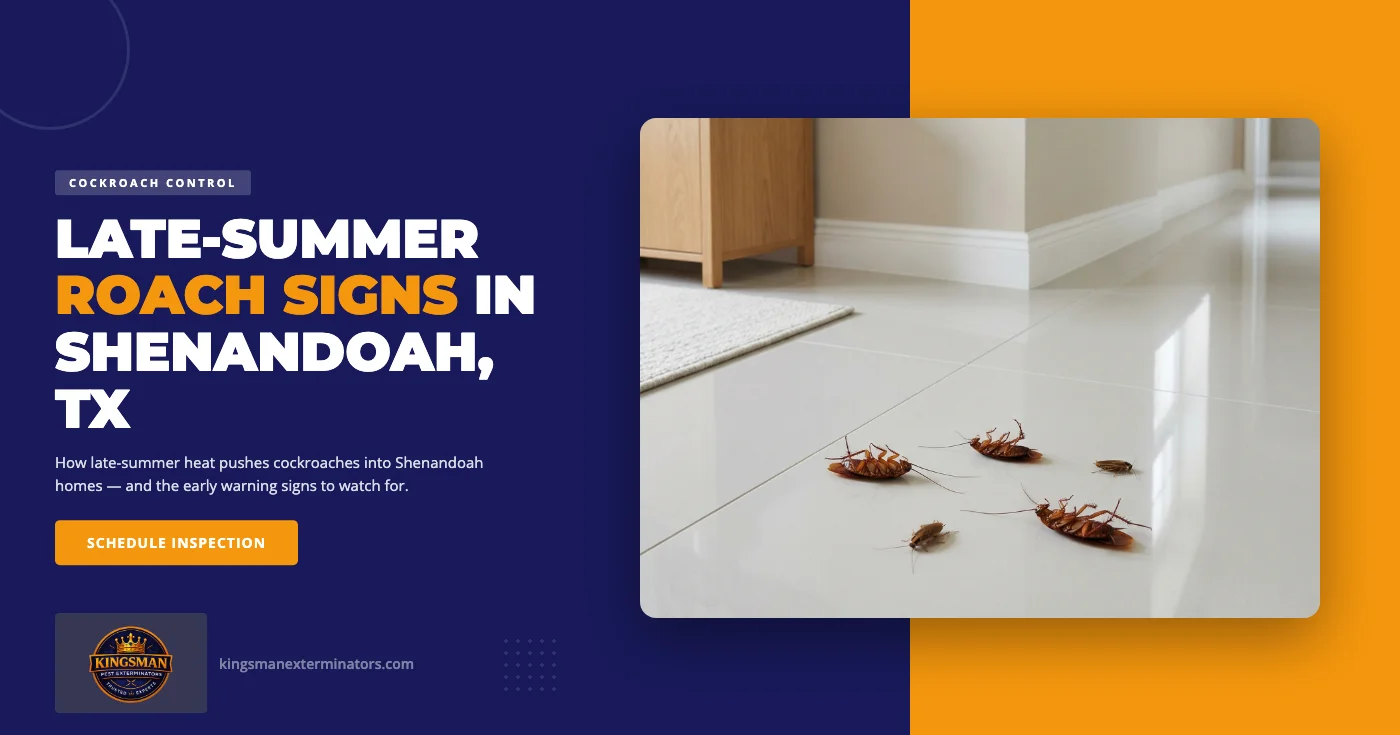
We have been running roach calls across Shenandoah, TX all summer, and the pattern is the same every August: a few large brown roaches spotted on the garage floor in July, then activity moves inside — first a nymph darting behind the toaster, then dark specks on the pantry shelf that look like ground pepper. That shift from outdoor sightings to indoor activity is the tell that a colony has found a route inside your Shenandoah home.
As the local team that handles cockroach control in Shenandoah, TX, we will walk through why late summer pushes roaches indoors, the warning signs that mean a colony is already inside, how to tell American from German cockroaches, and why hardware-store spray rarely gets rid of the problem.
Why Cockroaches Move Indoors in Shenandoah During Late Summer
Shenandoah sits in the humid subtropical belt that runs up from the Gulf Coast, and by the second half of August the outdoor conditions that fed the roach population all summer start to work against it. Dry stretches between storms and a drop-off in outdoor food sources push roaches toward the one place in a Shenandoah neighborhood that reliably offers water, warmth, and food around the clock — the inside of your house.
American cockroaches — the large reddish-brown "palmetto bugs" most Shenandoah homeowners recognize — nest outdoors year-round in mulch beds, storm drains, meter boxes, and the gap under a pier-and-beam foundation. As the ground dries in late summer, colonies push closer to the house and follow plumbing penetrations, weep holes, and slab joints inside. German cockroaches — the small tan roaches that live entirely indoors — arrive as hitchhikers in cardboard boxes, used appliances, and grocery bags any time of year.
Once inside a Shenandoah home in August, either species finds a perfect climate: A/C holds temperature and humidity in the exact band roaches prefer, sinks and drains keep them hydrated, and the pantry supplies steady food. A small pocket of activity can turn into a full infestation before Labor Day.
Early Warning Signs of a Cockroach Infestation
Roaches are secretive and nocturnal, so the sighting is almost never the first sign. These are the four warning signs our Shenandoah technicians look for, in the order homeowners actually notice them:
- Droppings that look like coffee grounds or black pepper. American cockroach droppings are small dark cylinders with ridges along the side; German droppings are smaller, like ground pepper, and cluster around harborage. Common Shenandoah spots: pantry shelves, top of the refrigerator, drawer tracks, and baseboards behind the trash can.
- A musty, oily odor near a suspect area. The Texas A&M "Insects in the City" cockroach factsheet notes that established roach populations produce chemical signals other roaches use to find harborage — those compounds create the pungent smell homeowners describe as the "roach smell." If a cabinet has picked up that odor since summer began, activity is close.
- Egg cases (oothecae) stuck in cracks and corners. American oothecae are dark brown, about a third of an inch long, and glued behind a picture frame, above a cabinet, or under a workbench. German females carry theirs until they hatch, leaving the empty case in the harborage. Repeat cases in the same spot means an active breeding site.
- A live roach spotted during daylight. Roaches are hard-wired to hide from light. Seeing one on the wall at 3 p.m. means the harborage is full and roaches are being displaced — often the last warning before nightly activity becomes visible.
Any two of these signs together — especially droppings plus odor in the same cabinet — mean a colony is already inside the structure.
American vs. German Cockroaches in Southeast Texas
Correct ID matters because the treatment plan is different for each. Two species account for almost every roach call we get across Shenandoah, Oak Ridge North, and The Woodlands.
American cockroach (Periplaneta americana). The large reddish-brown roach most Southeast Texas homeowners think of when they hear "palmetto bug." Adults reach one and a half inches, fly short distances in hot weather, and nest primarily outdoors. Indoor sightings trace back to a moisture-rich entry point — a slab crack near a slow leak, a garage floor drain, or the plumbing chase behind a laundry-room wall. The parent colony is almost always outside. Frequent Shenandoah entry points: storm-drain covers, weep holes in brick veneer, gaps around A/C line sets, and the space under the garage-door threshold.
German cockroach (Blattella germanica). Small — about a half-inch — light tan with two dark stripes behind the head. German cockroaches live inside human structures and rarely survive outdoors in North Houston. An infestation almost always starts as a hitchhiker: a used microwave, a cardboard box from a warehouse, groceries from a heavily infested store shelf, or a bag brought back from a hotel. Because reproduction is fast — an ootheca every few weeks with dozens of eggs — a small introduction turns into hundreds of insects across the kitchen and bath in weeks. Control requires an interior baiting program rather than a perimeter treatment.
If the roaches in your Shenandoah home are large and reddish-brown near garage doors, foundation lines, or plumbing openings, you are looking at American cockroaches pushing in from outside. If they are small and tan around the kitchen sink, dishwasher, or refrigerator motor housing, you have a German cockroach problem — and it needs to be handled quickly.
Where Roaches Nest Inside Your Home
By the time roaches show up in the open, they have been living in concealed harborage nearby for weeks. When our technicians inspect a Shenandoah home, these are the spots that consistently turn up active nests:
- Behind and under the refrigerator — motor heat, drip-pan moisture, and food debris under the coils create a perfect German cockroach harborage.
- Inside the dishwasher shell and along the door gasket — steady warmth and humidity, out of sight, with food scraps at every cycle.
- Behind the range and inside range-hood vents — cooking heat and grease residue in the wall gap behind the stove.
- Under kitchen and bathroom sinks with slow leaks — damp cabinet floors around plumbing penetrations attract both species.
- Utility rooms and water-heater closets — the pan under the water heater, the drain line behind the washer, and the A/C air handler.
- Garage, exterior storage, and pier-and-beam crawlspaces — the classic American cockroach staging area before they push through a slab crack or weep hole inside.
Shenandoah homes backing to greenbelt, drainage easements, or wooded lots almost always host an outdoor American roach population by August, and a single Kingsman inspection often turns up more than one indoor harborage.
Health Risks of a Cockroach Problem
Cockroaches are not a cosmetic problem. An active infestation puts real pressure on the health of everyone in the home — especially children, older adults, and anyone with asthma or seasonal allergies. The Texas A&M "Insects in the City" cockroach factsheet notes that roaches "can spread disease and produce allergens that can lead to asthma, especially in children." The CDC/ATSDR environmental triggers of asthma reference is direct: "Cockroach droppings may be one of the most under appreciated allergens in the indoor environment," reporting sensitization rates as high as 36 percent in inner-city asthmatic children, with exposure driving measurable increases in wheezing, missed school days, ER visits, and hospitalizations.
Roaches also contaminate food-contact surfaces as they travel from drains and garbage into the pantry. Bacterial pathogens on their bodies — Salmonella, E. coli, and staph — are deposited on plates, silverware, cutting boards, and inside opened food packaging. For a Shenandoah family cooking meals at home, a growing German cockroach population in the kitchen is a real kitchen-hygiene concern.
Why DIY Roach Control Rarely Works
By the time you see enough activity to reach for the hardware-store aerosol, the colony is well past what a surface product can control. Every DIY attempt shares the same three weaknesses.
First, contact sprays only kill the roaches you see. Visible foragers are a small fraction of the population; nymphs, gravid females, and freshly laid oothecae sit in a harborage crack you cannot reach. A couple of days of relief, then the population rebuilds from eggs already in place.
Second, repellent sprays scatter German cockroaches into new harborage. Instead of pulling the colony to a bait station where the active ingredient reaches the nymphs, aerosols push survivors out of the kitchen and into wall voids across the rest of the house — turning a contained problem into a house-wide one.
Third, treating the roaches without correcting the moisture, food, and entry-point conditions leaves the trigger in place. American roaches follow humidity to the same slab crack every year; German roaches thrive wherever grease, crumbs, and warm harborage sit together. Effective control means locating the harborage, treating with baits and non-repellents formulated for the species, correcting attractants, and sealing exterior gaps — none of which is achievable from a can under the sink.
How Kingsman Pest Eliminates Cockroaches in Shenandoah
When you reach out for cockroach control in Shenandoah, our licensed, insured, background-checked technicians start with a full inspection inside and outside the home before we treat anything. The goal is to identify the species, locate the harborage, and map every route between the two.
Outside, we walk the perimeter for American cockroach staging points: mulch piled against the siding, storm-drain covers, gaps around utility penetrations, and weep holes. Anything active outdoors is treated at the source and every entry route is flagged for pest exclusion. Inside, we pull the range, inspect behind the refrigerator, check every sink cabinet and water-heater closet, and — for a German cockroach — set up a targeted bait and monitor program in the kitchen and adjacent baths.
Treatments rely on low-toxicity, eco-friendly baits and non-repellent applications formulated for structural roaches. Foragers carry the active ingredient back to the harborage — that is what collapses the population, including nymphs and unhatched egg cases. Once activity is down, we finish with pest exclusion, sealing utility penetrations, weep holes, garage-door thresholds, and slab transitions.
Every treatment is backed by our 100% Satisfaction Guarantee with free re-treatments: if activity returns between visits, we come back at no charge. Trusted, local, eco-friendly service, with same-day and next-day appointments typically available across Shenandoah, Oak Ridge North, The Woodlands, Spring, Conroe, and the rest of North Houston.
Frequently Asked Questions About Cockroaches in Shenandoah, TX
Does seeing one roach mean I have an infestation?
Not automatically for American cockroaches — a single palmetto bug that pushed in on a hot night is not the same as a colony. But two or more within a week, or one during daylight, means harborage is almost certainly inside the structure. Any German cockroach sighting should be treated as an infestation — they rarely appear as isolated hitchhikers.
Why do I only see roaches at night in my Shenandoah kitchen?
Cockroaches are nocturnal — they forage when the lights are off. Visible daytime activity usually means the existing harborage is overcrowded, so a shift from "occasional night sighting" to "daytime activity" is a sign the colony is expanding.
Are cockroaches a real health risk or just a nuisance?
A real health risk. Roach droppings, shed skins, and saliva are among the most significant indoor allergens the CDC/ATSDR tracks for asthma, and roaches carry Salmonella, E. coli, and staph from drains and garbage onto countertops, silverware, and inside food packaging.
How long does professional cockroach treatment take to work?
For American cockroaches, activity drops within days. For German cockroaches, meaningful collapse usually takes two to four weeks as bait moves through the colony and unhatched egg cases finish their cycle. A fast knock-down without baiting means the harborage was untouched — the slow decline is what clears the house.
Get Local Cockroach Help Before Fall Activity Peaks
If large brown roaches are on the garage floor or a small tan roach has shown up in the kitchen this month, this is the window to handle it — before the population expands through fall. Our Kingsman technicians know where roaches nest in Montgomery County homes and can typically be on site within one business day. Reach out for trusted, eco-friendly cockroach control in Shenandoah, TX, backed by our 100% Satisfaction Guarantee with free re-treatments.