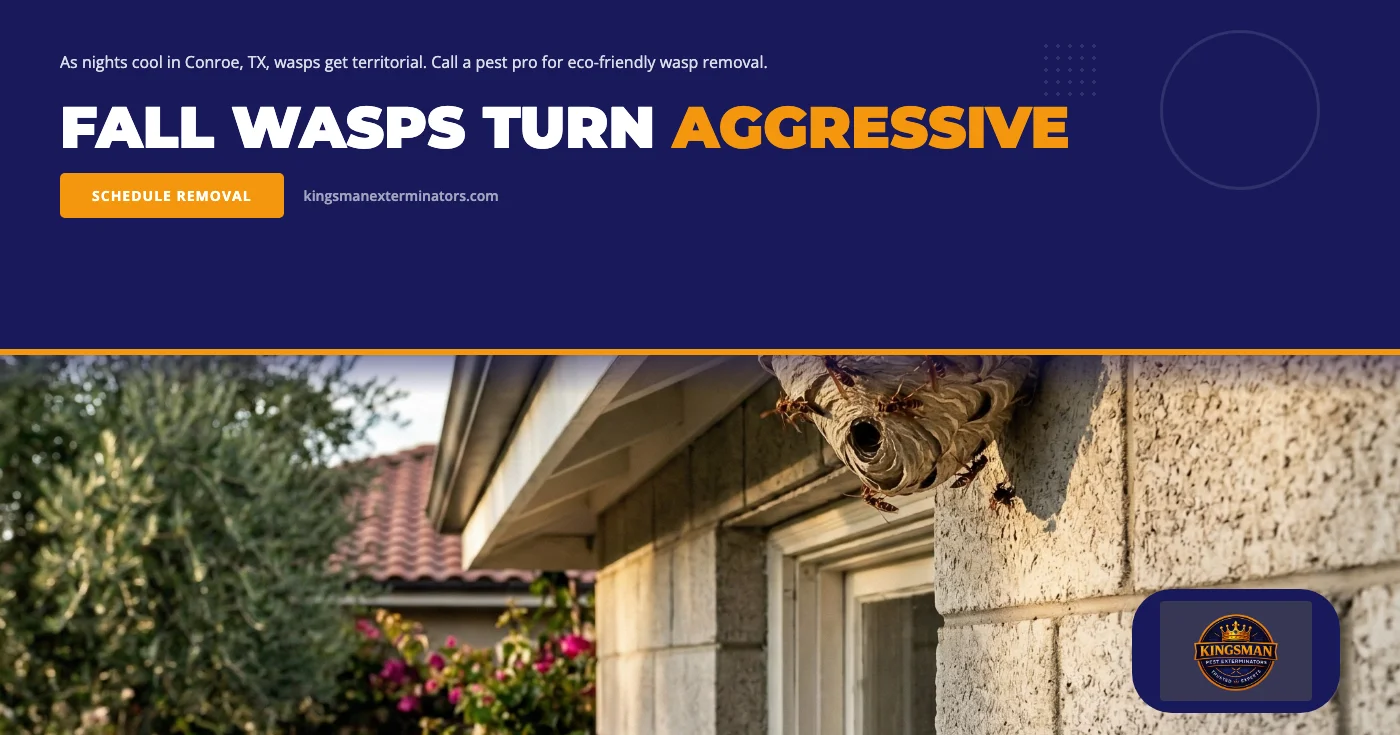
By late September, homeowners across Conroe start noticing something they have not seen all summer — wasps that will not back off. A colony that ignored you in June now sends three or four workers after anyone who walks past the porch. It is the peak of the annual wasp cycle in the Gulf Coast climate, and September through mid-November is when our technicians get more emergency calls for stinging insects than any other stretch of the year.
As the local team providing wasp control in Conroe, TX, we handle nest inspections and removals across Montgomery County every week during fall. Below, we cover why wasps become so aggressive in September and October, how to tell yellow jackets, paper wasps, and hornets apart, where nests hide on your property right now, when a nest needs professional removal, how our team handles stinging-insect calls, and how to keep your outdoor spaces clear through the rest of fall.
Why Wasps in Conroe, TX Become More Aggressive in September and October
The aggression is not a personality change — it is the predictable end of the colony's annual cycle. According to Texas A&M AgriLife Extension, a paper wasp or yellow jacket colony that started with a single overwintered queen in April swells to peak worker count by late summer. By September a mature southern yellow jacket nest in the Conroe area can hold several thousand workers, and paper wasp umbrellas that were quiet in June are now protected by dozens of adults.
The behavioral trigger comes from the diet cycle. Through summer, workers hunt caterpillars and other soft-bodied prey to feed the larvae, and in exchange the larvae secrete a sugary liquid the adults rely on for their own carbs. In late summer the queen stops laying and the last larvae mature — leaving thousands of adult workers with no larval sugar and only weeks to live. They scavenge soda cans, fallen fruit, pet food bowls, and hummingbird feeders, and their tolerance for anything near the nest drops to zero. Warmer Gulf Coast fall temperatures extend the pressure — Conroe rarely sees a hard freeze before mid-November, giving the colony an extra month of hungry, adult-only activity.
The Difference Between Yellow Jackets, Paper Wasps, and Hornets in the Houston Area
Correct identification changes the removal plan and, in some cases, the urgency of the call. In the Conroe area, three groups of stinging wasps show up on nearly every fall service.
Paper wasps (Polistes species). The insect most homeowners call a "red wasp" is almost always Polistes carolina or Polistes rubiginosus — about one inch long, rust-red, with dark smoky wings held along the body. The nest is the small, open umbrella hanging from a single stalk under eaves, porch ceilings, mailbox posts, and shed rafters. Colonies are smaller — 20 to 200 adults — but they defend the visible comb aggressively and cause most porch-and-patio stings in the North Houston area.
Yellow jackets (Vespula species). Yellow jackets are shorter and stockier — about half an inch — with sharp yellow-and-black bands and no rust tones. According to the Texas Apiary Inspection Service, yellow jackets are primarily ground nesters, but aerial nests are found in trees, under eaves, and inside walls. Around Conroe, the southern yellow jacket (Vespula squamosa) and the eastern yellow jacket (Vespula maculifrons) build in old rodent burrows, wall voids, under sheds, and in landscape beds. Colony size is the reason yellow jackets are dangerous: several hundred to several thousand workers can respond in seconds if the nest is disturbed.
Bald-faced hornets. Despite the name, the bald-faced hornet is actually a large yellow jacket. It is about three-quarters of an inch long, jet black with ivory-white markings on the face and abdomen. Bald-faced hornets build large, gray, football-shaped paper nests hanging from tree branches and eaves — sometimes as big as a basketball by September — and their sting is one of the more painful stinging-insect encounters you can have.
Where Wasp Nests Hide Around Your Conroe Property in Late Summer
Wasps in Conroe build in places that stay out of direct sight until the colony is large enough to matter. On a first inspection, our technicians check the following locations in this order.
- Under eaves, soffits, and porch ceilings. Paper wasps prefer overhangs that shade the nest through the hottest part of the day. The east and north sides of the house are the highest-probability spots.
- Ground holes, rodent burrows, and landscape beds. Yellow jackets take over abandoned burrows and hollow root systems. A steady stream of wasps flying in and out of a single one-inch hole in the lawn is the classic sign.
- Attic vents, dryer vents, and weep holes in brick veneer. Any vent with a steady stream of wasps entering or leaving is likely covering an interior wall-void nest.
- Sheds, playsets, patio furniture, and outdoor grills. Grill covers, umbrella joints, and stored patio chairs are common surprise-sting locations.
- Wooden fences and mailbox posts. Paper wasps build small umbrella nests in the notches at the tops of fence rails and inside hollow mailbox posts constantly.
- Trees, shrubs, and dense hedges. Bald-faced hornet nests hide in mature shrubs and the lower canopy, visible only after leaves drop.
- Wall voids behind vinyl or brick siding. Yellow jackets that entered a small gap in June can build a nest against the interior wall board by September — the highest-risk fall calls our team receives in Conroe.
Warning Signs That a Wasp Nest Near Your Home Requires Professional Removal
Some nests can wait for a natural late-fall die-off. Others should be handled before a family member, contractor, or pet gets stung. Our team treats a nest as a priority removal when any of the following are true.
- Continuous adult traffic at a single entry point. Ten or more workers per minute entering one hole, vent, or crack means a mature colony with hundreds to thousands of workers behind the wall or in the ground.
- Nest larger than a softball, or a bald-faced hornet nest of any size. Even mowing within twenty feet can trigger a swarm response.
- Location near a doorway, walkway, porch, patio, or driveway. Any nest within six feet of foot traffic is a routine sting risk.
- Anyone in the household is allergic to stings. Do not attempt DIY removal if a resident carries an EpiPen or has ever had an emergency-room stinging reaction.
- The nest is inside a wall void, attic, or crawl space. Interior nests cannot be reached with hardware-store aerosols without pushing the colony deeper into the wall.
- Repeated stinging without touching the nest. If workers attack anyone within fifteen to twenty feet, the colony has reached late-season defensive posture.
Hardware-store products are formulated for isolated umbrella nests of six or eight paper wasps in the open. A ground yellow jacket colony or an in-wall bald-faced hornet nest rarely responds to contact spray — while giving the colony full warning to defend.
How Kingsman Pest Handles Wasp and Stinging Insect Removal in Conroe, TX
Wasp control done well needs species identification skills, the right products, and protective equipment sized for the colony. On a fall wasp call in Conroe, our licensed, insured, background-checked technicians:
- Confirm the species and locate every nest. The property gets a full perimeter walk, eave check, ground-hole check, and vent survey before anything is treated.
- Match the treatment to the situation. Paper wasp umbrellas, ground yellow jacket nests, in-wall colonies, and hornet nests each get a different combination of professional-grade dust, aerosol, or residual product, applied at label rates and directed at the nest.
- Neutralize the nest and remove the physical structure where practical. Removing the paper nest reduces the chance of a rebuild on the same site next year.
- Seal the entry point. A treated wall-void or vent hole that is not physically closed will be reused. Larger structural gaps are addressed through our pest exclusion services.
- Provide a written service report documenting the species, location, treatment, and any exclusion work performed.
Our approach favors eco-friendly, low-toxicity treatments wherever the situation allows. Products go straight to the nest, which keeps residuals off play areas and garden beds and gentle around pets and family. Same-day and next-day service is available for active stinging-insect calls, and every wasp service in Conroe is backed by our 100% Satisfaction Guarantee with free re-treatments.
Keeping Your Outdoor Spaces Free of Stinging Insects Through the Fall Season
Once an active colony has been treated, the goal for the rest of fall is preventing another queen from claiming your Conroe property next spring. Fall exclusion is the single most effective step a homeowner can take.
Seal every small gap on the exterior. Overwintering queens tuck into siding voids, sheds, and attics — cover weep holes with metal wool, screen attic and gable vents, caulk siding penetrations, and repair torn window screens.
Reduce late-season food sources. Keep trash lids tight, rinse recycling, harvest fallen fruit within two days, take down hummingbird feeders during the hungriest weeks of September and October, and skip open-top drinks on the patio.
Inspect the property monthly through the first frost. A quick walk catches new umbrella nests before they mature — check eaves, mailbox posts, fence rails, grill covers, and stored patio furniture.
Cut back landscaping that touches the house. Six to twelve inches of clearance between vegetation and siding removes most of the sheltered pockets queens use to overwinter.
Schedule an exterior treatment before winter. A residual treatment along soffits, eaves, and vent openings in late October or early November discourages queens from selecting the property as an overwintering site.
Frequently Asked Questions About Fall Wasp Activity in Conroe, TX
Are fall wasps dangerous to people who are not allergic?
Yes. Yellow jacket and bald-faced hornet stings are painful for anyone, and unlike a bee, a single wasp can sting multiple times. A disturbed ground nest or wall-void colony can deliver dozens of stings within seconds — enough venom to send a healthy adult to the emergency room without any allergic reaction.
Can I wait for the wasps to die off in winter?
Sometimes. A small paper wasp umbrella in a low-traffic corner of the yard will die back after the first hard freeze and can often be left alone. A yellow jacket colony inside a wall or a bald-faced hornet nest at eye level is not something to wait out — sting risk stays high for the six to eight weeks between the aggression peak and the first freeze.
Are your wasp treatments gentle around pets and family?
Yes. Our technicians use professional-grade wasp products at label rates, applied directly to the nest and entry point rather than broadcast across the yard. Products dry quickly and are not applied in play areas or garden beds. We use low-toxicity options wherever the situation allows.
How fast can you respond to an active wasp call in Conroe?
Same-day or next-day service is standard for active stinging-insect calls during fall. When someone in the household is allergic, the call moves to the top of the day's route.
Handle Wasp Season in Conroe Before the Aggression Peak Ends in a Sting
Fall is the shortest and highest-risk stinging-insect window of the year in Conroe. If you have spotted an umbrella nest under an eave, a steady stream of wasps at a ground hole, or a football-sized gray paper nest in a shrub — do not chip away at it with a broomstick or empty a hardware-store can from ten feet away. Our team handles wasp identification, nest removal, entry-point sealing, and preventative fall treatment throughout Conroe and greater Montgomery County. Reach out for trusted, eco-friendly wasp control in Conroe, TX, backed by our 100% Satisfaction Guarantee with free re-treatments.