
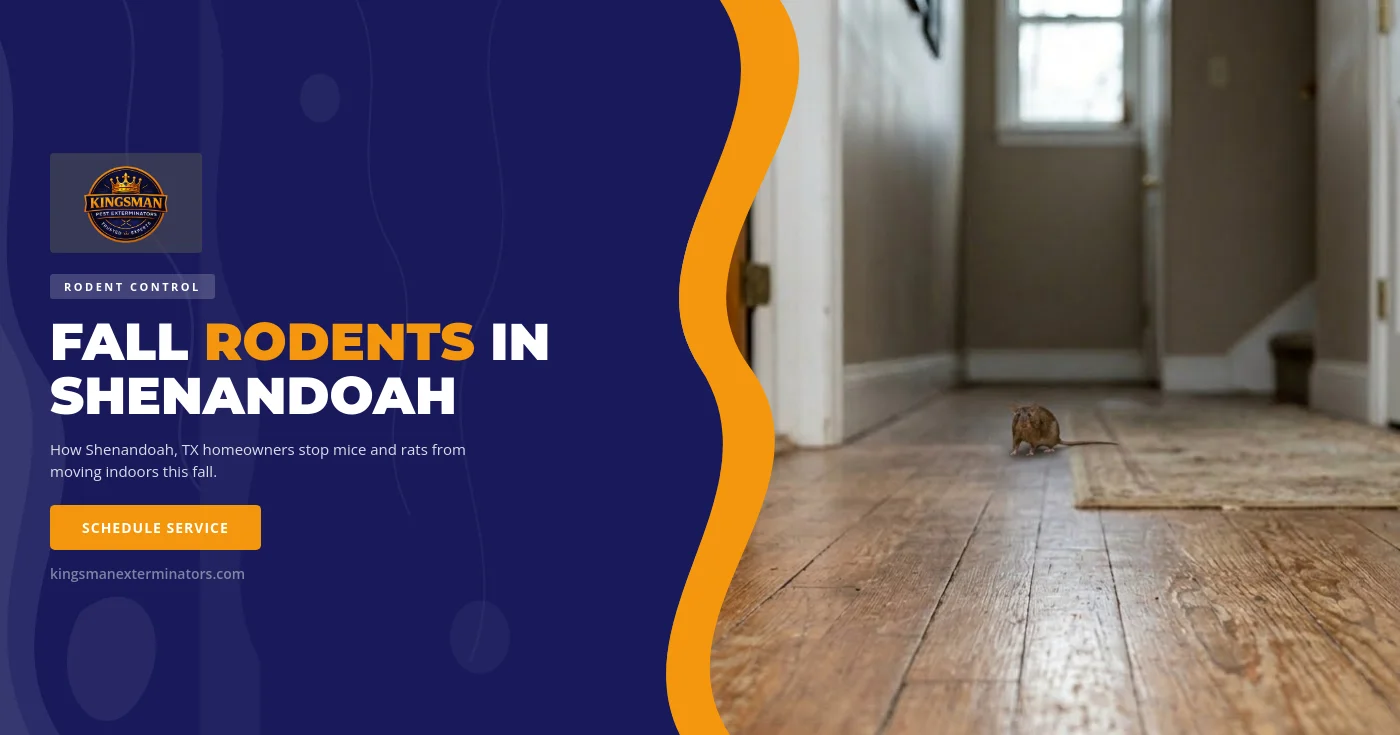
When the first cold front sweeps through Montgomery County in October, most Shenandoah, TX homeowners enjoy the break from summer heat. Mice and rats experience the same temperature shift very differently — as a signal to find shelter indoors before nights get colder. Nighttime lows dropping into the 60s set off a predictable migration from brush piles, drainage lines, and tree canopies into the warm, stable interiors of homes across our service area. By Thanksgiving, those homes are either sealed and quiet or hosting a breeding population behind the walls.
As the local team handling rodent control in Shenandoah, TX and the surrounding Woodlands area, we take more fall rodent calls between late September and January than any other time of year. The pattern is consistent, the entry points are predictable, and the window to stop an infestation before it establishes is short. Below, we cover why fall drives rodents indoors, how to spot the earliest signs, where mice and rats get in, the health risks every family should understand, and the four-step process our technicians use to clear infestations and keep them out.
Why Fall Sends Rodents Indoors in Shenandoah, TX
Rodents don't hibernate on the Gulf Coast. Our mild winters mean roof rats, Norway rats, and house mice stay active year-round in Montgomery County. What shifts in fall is the pressure that pushes them toward human structures. Three forces move at once: nighttime temperatures drop into the low 60s and upper 50s, outdoor food sources become unpredictable as insects die off and seed crops disappear, and the brush and leaf-litter harborage that sheltered them all summer thins out. All three together make a warm attic or garage suddenly irresistible.
Shenandoah's position just north of The Woodlands places it in a stretch of Montgomery County where mature pine canopy, residential density, and ongoing commercial construction converge. That mix is engineered for roof rats, which travel along fence lines, utility wires, and tree limbs and drop into attic vents and soffit gaps. House mice and Norway rats work the ground game — foundation cracks, slab penetrations, garage thresholds, and HVAC returns. By the time scratching sounds reach a bedroom ceiling, the colony has usually been inside for a week or more and started breeding.
How to Identify a Mice or Rat Infestation in Your Home
Most rodent infestations in Shenandoah, Texas get discovered weeks after they begin. Rodents are nocturnal, cautious, and skilled at using the parts of a home people never check — attic voids, wall cavities, behind kick plates under cabinets. Early identification shortens treatment time and limits damage. Watch for these indicators:
- Droppings in pantries, under sinks, behind appliances, or along garage walls. House-mouse droppings are rice-grain sized; rat droppings are closer to a raisin.
- Gnaw marks on wood trim, cardboard boxes, food packaging, or electrical insulation. Fresh gnawing shows light-colored wood or shaving residue underneath.
- Scratching, scurrying, or thumping noises in the attic, walls, or above the ceiling — especially right after sunset or just before dawn.
- Shredded insulation, paper, or fabric tucked into corners of the garage, pantry, or attic — classic nesting material.
- Rub marks along baseboards, pipes, or beams. Rodents follow consistent travel paths and leave greasy dark smears from the oils on their fur.
- Pet behavior changes — cats and dogs fixated on a wall, cabinet, or appliance often hear what you don't.
- A musky, ammonia-like odor in an enclosed space like a pantry or utility closet, often the first sign of an established nest.
Any single sign warrants a professional inspection. Two or more together almost always indicates an active infestation that will keep growing until the colony is cleared and entry points are closed.
Common Entry Points Rodents Use to Get Into Texas Homes
Rodents don't chew their way through brick or concrete — they exploit the gaps a builder, roofer, or plumber left behind. The uncomfortable truth about mice control in Shenandoah, TX is that nearly every home has at least a dozen openings large enough to admit a mouse or rat. According to Texas A&M AgriLife Extension's Managing Rats and Mice guide, a house mouse can slip through a gap as narrow as a quarter-inch — about the diameter of a #2 pencil — while a Norway rat only needs a half-inch opening.
The entry points we identify most often on Shenandoah inspections include:
- Gaps under exterior and garage doors, especially where weatherstripping has worn through or garage door seals have hardened in the Texas heat.
- Utility and plumbing penetrations where pipes, cables, or conduit enter the home — often sealed with expanding foam that rodents chew through in a single night.
- Attic vents, gable vents, and soffit gaps — the primary roof rat superhighway in homes with mature tree canopy nearby.
- Weep holes in brick veneer, which are necessary for drainage but double as entry points if left unprotected by stainless mesh.
- Dryer and bathroom exhaust vents with damaged or missing exterior flaps.
- HVAC return penetrations and expansion gaps around slab-on-grade construction common in Shenandoah developments.
- Chimney flues without caps or screens.
- Garage-to-house pedestrian doors with worn thresholds — a direct interior route once the garage perimeter is breached.
Our exclusion work focuses on identifying and sealing every one of these points with materials rodents cannot chew through — hardware cloth, copper mesh, galvanized sheet metal, and concrete patch — not foam or caulk alone.
Health Risks of a Rodent Infestation Homeowners Should Know
Mice and rats are not just a nuisance in the walls. They carry documented health risks for every household they enter, and those risks grow the longer the infestation runs. Rodents contaminate food, surfaces, and indoor air with urine, droppings, and dander — exposing families to pathogens and allergens that affect children, pets, and anyone with respiratory conditions most severely.
The health risks most relevant to our Shenandoah clients include:
- Hantavirus Pulmonary Syndrome — spread by inhaling dust from dried rodent urine or droppings, often during attic cleanup or shed clear-outs. Rodent exclusion is the primary preventive measure recognized by public health authorities.
- Salmonellosis — bacterial infection transmitted when rodents contaminate pantry food, counters, or utensils with feces or urine.
- Leptospirosis — transmitted through water or surfaces contaminated with rodent urine; pets face particular exposure risk through contaminated puddles or outdoor water bowls.
- Rat-bite fever — rare but serious, with highest risk in homes where children or pets interact with infested storage spaces.
- Allergen and asthma triggers — rodent dander, urine proteins, and droppings worsen respiratory conditions, particularly for children with existing asthma.
Rodents also damage homes in ways that create secondary hazards. Gnawed electrical wiring is a documented cause of residential fires in Texas. Chewed plumbing lines produce water damage inside wall cavities before anyone notices a leak. Shredded insulation loses its R-value and raises energy bills. Protecting your family's well-being and your home's structural integrity are two sides of the same job.
DIY Traps vs. Professional Rodent Control: What Actually Works
Snap traps and store-bought bait stations have a place — mostly for the occasional single mouse in a garage or outbuilding. For an established infestation, DIY almost always falls short, and understanding why helps homeowners make a faster decision about when to bring us in.
A single breeding pair of house mice can produce 30 to 60 offspring in a year under favorable indoor conditions. By the time a homeowner catches two or three mice in snap traps, dozens more are usually behind the walls, in the attic, or in the crawl space. Store-bought baits are typically weak formulations placed where rodents don't actually travel, and over-the-counter rodenticides without tamper-resistant housings raise legitimate concerns around pets and curious children.
Professional rat exterminator services in Shenandoah, TX work differently. We start with a full-property inspection that maps travel routes, identifies the specific entry points responsible for the infestation, and locates nesting zones. We deploy locked, tamper-resistant bait stations placed on travel paths rodents actually use — combined with professional-grade snap and electronic traps in interior zones. Most importantly, we seal the entry points. Trapping without exclusion is a treadmill; exclusion plus trapping ends the problem.
Kingsman Pest's Rodent Control Process in Shenandoah, TX
When you call us for fall rodent prevention in the Woodlands area, we follow a four-step process built around getting rodents out and keeping them out.
Step 1: Full-property inspection. A licensed, insured, background-checked technician walks the exterior, attic, garage, and interior with a flashlight and inspection mirror. We identify every active entry point, map rodent travel routes, and look for evidence of nesting, breeding, and interior food sources.
Step 2: Exclusion work. We seal entry points with materials rodents cannot chew — copper mesh, hardware cloth, concrete patch, and galvanized flashing. Worn door sweeps and garage seals get replaced when needed. This is the most important step in long-term control, and the one most other treatments skip.
Step 3: Targeted trapping and baiting. We install professional snap traps, electronic traps, and tamper-resistant bait stations where rodents actually travel. Our treatments are selected with pets and family in mind — eco-friendly, low-toxicity protocols that minimize non-target exposure.
Step 4: Follow-up and monitoring. We return within 7 to 14 days to check devices, remove captures, confirm the colony is cleared, and verify no new entry activity has started. Ongoing bi-monthly service keeps your home protected year-round, with rodent monitoring included alongside general pest coverage.
Every rodent service is backed by our 100% satisfaction guarantee with free re-treatments if activity returns between visits. We're locally owned, licensed, and insured — and because our technicians live in the same Montgomery County neighborhoods we service, we understand how fall rodent pressure moves through Shenandoah, The Woodlands, Spring, Conroe, Oak Ridge North, and Panorama Village.
Frequently Asked Questions About Fall Rodent Control in Shenandoah, TX
When should I schedule rodent control before winter?
Late August through early October is the ideal window across the Shenandoah service area. Sealing entry points and establishing monitoring before the first cold front dramatically reduces the chance of rodents moving in. Waiting until you hear scratching usually means a breeding population is already established, and treatment takes longer and costs more.
What size gap can a mouse actually squeeze through?
A house mouse can slip through a gap as narrow as a quarter-inch — about the width of a #2 pencil. Norway rats need about a half-inch; roof rats about the same. If a pencil fits through an opening, so does a mouse. That's why our exclusion work focuses on even the smallest penetrations around pipes, vents, and door frames.
Are rodenticides a concern around pets and children?
Over-the-counter rodenticides placed loosely or in open trays carry real risks. Our team uses locked, tamper-resistant bait stations positioned on rodent travel paths where pets and children cannot access the bait itself. We also combine baiting with mechanical trapping to minimize rodenticide dependence overall, and all treatments follow eco-friendly, low-toxicity protocols.
How long before I see results after treatment?
Most homeowners notice a sharp drop in rodent activity within the first week, with the colony typically cleared in two to three weeks. Long-term results depend on sealing entry points, not just trapping. Our follow-up visit at 7 to 14 days confirms the reduction and catches new activity before it establishes.
Protect Your Shenandoah, TX Home Before Fall Rodent Pressure Peaks
If you're hearing scratching above the ceiling, finding droppings in the pantry, or noticing a musky odor in the garage, fall rodent migration into your home is already underway. Early intervention is measured in one or two service visits; late intervention is measured in months of noise, damage, and health exposure. Our Kingsman technicians know where fall rodent activity concentrates in Shenandoah homes and can typically inspect and quote within one business day. Reach out for trusted, eco-friendly rodent control in Shenandoah, TX, backed by our 100% satisfaction guarantee with free re-treatments and same-day or next-day availability through fall and winter.