
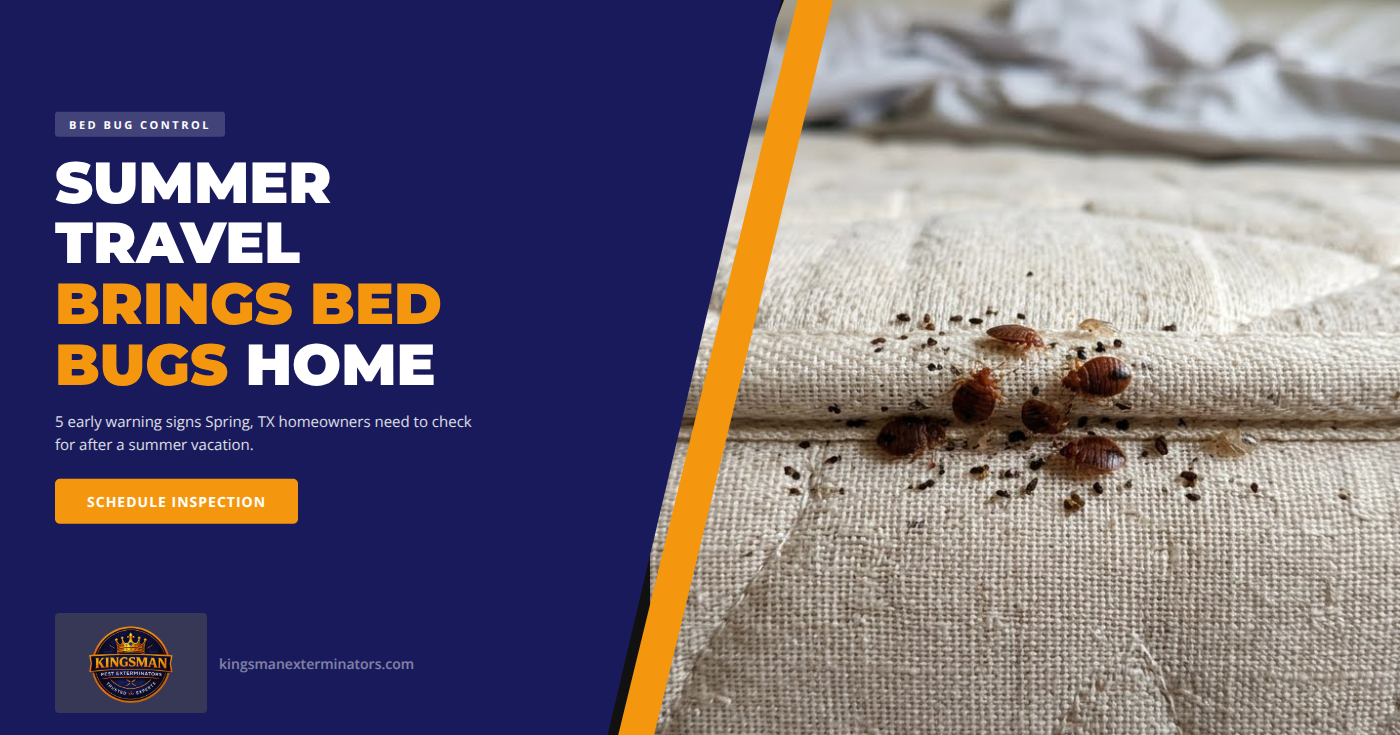
Every June and July, we get the same calls from Spring, TX homeowners: "We just got back from a trip and now I think we have bed bugs." It's not coincidence. Summer travel season is bed bug season — and the houses we visit between June and August almost always have a recent hotel stay, cruise, or out-of-state family trip behind the infestation.
At Kingsman Pest Exterminators, we treat bed bug cases across Spring, The Woodlands, Conroe, and the surrounding Montgomery County neighborhoods. Here's what every Spring, TX household should know before their next trip — and what to look for the night you unpack.
Why Bed Bug Cases Rise in Spring, TX Every Summer
Bed bugs are a year-round problem in Texas, but the curve is real. From late May through August, our bed bug call volume across Spring and the wider North Houston area roughly doubles compared to winter. The reason isn't biology — bed bugs don't care about the weather inside your house. It's travel.
Summer is when families take their longest trips of the year: beach weeks in Galveston, Disney runs to Orlando, family weddings out of state, cruises out of the Port of Houston, and weekend visits to the Hill Country. Each one is an opportunity for a single fertilized female bed bug to ride home in a suitcase and start a new infestation in a Spring, TX master bedroom.
Spring is also a convenient launchpad for that travel. With Bush Intercontinental Airport less than 20 minutes south and visiting family using guest rooms in Augusta Pines, Gleannloch Farms, and Imperial Oaks, the volume of suitcases moving through local homes between Memorial Day and Labor Day is enormous. We see the results in our schedule every July.
How Bed Bugs Hitchhike From Hotels, Airbnbs, and Rental Cars
Bed bugs don't fly and they don't jump. They move by hitchhiking — riding on luggage, clothing, purses, backpacks, and occasionally even a kid's stuffed animal. A single mated female can lay 200 to 500 eggs over her lifetime, and she only needs one ride home to establish a colony.
The most common pickup points we see in our Spring, TX bed bug cases are:
- Hotel rooms. Even four- and five-star properties get bed bugs because they're brought in by guests. The bugs hide in mattress seams, behind the headboard, in nightstand drawers, and along the carpet edge against the wall.
- Short-term rentals. Airbnbs, VRBOs, and beach condos often see less rigorous between-guest inspections than chain hotels, and bed bugs can live months between bookings.
- Cruise ship cabins. Tight quarters, constant turnover, and shared luggage storage make ship cabins a known hitchhiker risk.
- Visiting guests' luggage. Family members staying in your guest room may unknowingly bring bed bugs from their own home or recent travels.
- Used furniture and resale finds. A summer garage-sale headboard or Facebook Marketplace bed frame can introduce an active infestation in one afternoon.
According to the U.S. EPA, bed bugs are now found in all 50 states, with the highest concentrations in densely populated travel corridors — which is exactly where Houston-area families tend to vacation.
5 Early Warning Signs You Brought Bed Bugs Home
The mistake most homeowners make is assuming they'll see the bugs first. By the time live bed bugs are crawling across the sheets in daylight, the infestation is usually weeks or months old. The earlier signs are subtler. Here are the five we tell every Spring, TX customer to watch for in the days after a trip.
1. Small, itchy red welts in a line or cluster, usually on arms or legs. Bed bug bites appear in groups of three to five along exposed skin — sometimes called the "breakfast, lunch, and dinner" pattern. They itch intensely and can take days to develop. Many people initially blame mosquitoes.
2. Tiny dark spots on sheets, mattress seams, or the box spring. These are bed bug droppings — dried blood that looks like specks made by a felt-tip pen. They smear rusty-red if wiped with a damp cloth. Check the corners and piping of the mattress first.
3. Small rust-colored stains on the pillowcase or sheets. When a bed bug is crushed in someone's sleep, it leaves a blood smear. One or two faint stains can be easy to miss; recurring stains every week are not.
4. Tiny pale yellow shells in mattress seams. Bed bugs molt five times as they grow. The shed skins are translucent, about the size of an apple seed, and accumulate where the bugs hide — one of the most reliable early warning signs.
5. A sweet, musty odor in the bedroom. An established bed bug population gives off a distinct sweet smell some describe as overripe raspberries or wet towels. If your bedroom suddenly smells "off" after a trip, take it seriously.
If you spot any one of these signs, don't wait for a second. Bed bug populations roughly double every 16 days. Early detection is the difference between a single-room treatment and a whole-house ordeal.
What to Inspect on Your Luggage and Clothes After a Trip
The hour you walk back through the front door is the single best window to stop a bed bug introduction. Here's the routine we recommend to every Spring, TX family heading out this summer.
Unpack in the garage, laundry room, or driveway — never the bedroom. The biggest mistake people make is hauling the suitcase straight to the closet or under the bed. If a bed bug rode home with you, that's where it'll establish.
Inspect the suitcase before opening it. Check seams, zippers, interior pockets, and the lining along the bottom with a flashlight. Adults are about the size of an apple seed; nymphs the size of a poppy seed.
Run all travel clothes through the dryer on high heat for at least 30 minutes. This is the most reliable step you can take. Sustained heat above 120°F kills bed bugs and their eggs at every life stage. Don't skip clothes that "didn't get worn" — the bugs don't care.
Vacuum the suitcase inside and out, then seal it in a plastic bag. Pay attention to wheels and seams. Empty the vacuum bag outside immediately into a sealed garbage bag.
Store the suitcase away from sleeping areas — garage, attic, or a sealed under-bed bin in a guest room. Never back in a bedroom closet.
Watch for bites for 7 to 14 days after returning. Bed bug bites can take one to 14 days to appear in people who haven't been previously sensitized.
Why DIY Foggers and Sprays Often Make Spring, TX Infestations Worse
When we walk into a Spring, TX home that's been battling bed bugs for weeks, we usually find the same evidence on the kitchen counter: a couple of bug bombs, a can of hardware-store bed bug spray, and a mattress encasement put on after the bugs had already spread to the box spring. We get it — when you find live bugs in your bed, you want them gone immediately. Unfortunately, those products often make a small problem much bigger.
Total-release foggers (bug bombs) are the worst offender. Bed bugs hide in cracks, behind baseboards, inside electrical outlets, and deep in mattress seams — places the fog can't reach. Worse, the chemical irritants cause the bugs to scatter into neighboring walls, adjoining bedrooms, and shared walls in townhomes and apartments. A one-room problem becomes a whole-house problem.
Over-the-counter pyrethroid sprays have a similar issue. Most bed bug populations in Texas now carry significant pyrethroid resistance — the bugs you can see and spray sometimes survive, and the ones hidden in the wall void are untouched. You feel like you're making progress because the visible bugs die. The hidden population keeps reproducing.
The other DIY misstep we see is throwing out the mattress and box spring before treatment. It feels satisfying, but unless the rest of the room is treated, the new mattress is reinfested within weeks. Bed bug populations live as much in the room as in the bed itself.
How Kingsman Handles Bed Bug Treatment in Spring and Montgomery County
Our bed bug control program for Spring, TX homes is built around three principles: thorough inspection, multi-stage treatment, and follow-up verification.
Inspection. A licensed technician walks the affected room and any adjoining spaces with a flashlight and mapping tools. We log every harborage point — mattress, box spring, headboard, nightstands, baseboards, electrical outlets, and carpet edges. This tells us how far the population has spread and what's realistic from one visit versus several.
Treatment. We combine EPA-registered residual products at harborage points, targeted contact treatment for live bugs and exposed eggs, and physical interventions like mattress and box spring encasements that trap surviving bugs. For heavier infestations, we layer in steam on furniture seams. Our products are chosen for effectiveness in real Texas homes — gentle around pets and children when applied and dried per label, not over-the-counter formulations that resistant local strains will shrug off.
Follow-up. Bed bug eggs are protected from many residual products and can hatch one to two weeks after the first treatment, which is why a single visit is almost never enough. Our standard program includes a re-treatment 10 to 14 days after the initial visit and a verification visit two to three weeks after that. If anything is still active, we keep going at no extra charge — that's part of our guarantee.
For families who want broader protection after a bed bug case is closed, we layer the home into our quarterly pest control services to keep mosquitoes, ants, roaches, and other summer pests in check at the same time.
If you've just gotten home from a trip and something feels off — bites, odd stains, that faint sweet smell — don't wait. We can usually get a Spring, TX inspection on the calendar within a day or two, and catching an infestation in week one instead of week six saves furniture, stress, and money.
Frequently Asked Questions
How do bed bugs get into a home after vacation?
They hitchhike. A single fertilized female can ride home in a suitcase, purse, or article of clothing and establish a colony within weeks. Hotels, short-term rentals, cruise ships, and visiting guests' luggage are the most common sources we see in Spring, TX cases.
What do bed bug bites look like on the legs?
Small, itchy red welts in a line or cluster of three to five, usually on exposed skin like legs, arms, neck, and shoulders. They can resemble mosquito or flea bites and may take one to 14 days to appear after the bite.
How do I check a hotel room for bed bugs?
Keep your luggage off the bed and floor when you walk in — set it in the bathtub or on the luggage rack. With a flashlight, inspect the mattress seams, the corners of the box spring, the back of the headboard, and the nightstand drawers. Look for live bugs, small dark spots, rust-colored stains, or shed shells. If you find anything, ask for a different room far from the original.
Do bed bugs go away on their own in Spring, TX homes?
No — they grow. Populations roughly double every 16 days under normal home conditions, and a single female can produce 200 to 500 eggs over her lifetime. Professional treatment is the reliable way to clear an infestation.
Are professional bed bug treatments gentle around pets and kids?
Yes. The products we use are EPA-registered for residential use and applied in targeted, low-volume amounts. We tell every household exactly when treated areas are ready for pets and children to return — usually a short window after the product has dried per label.