
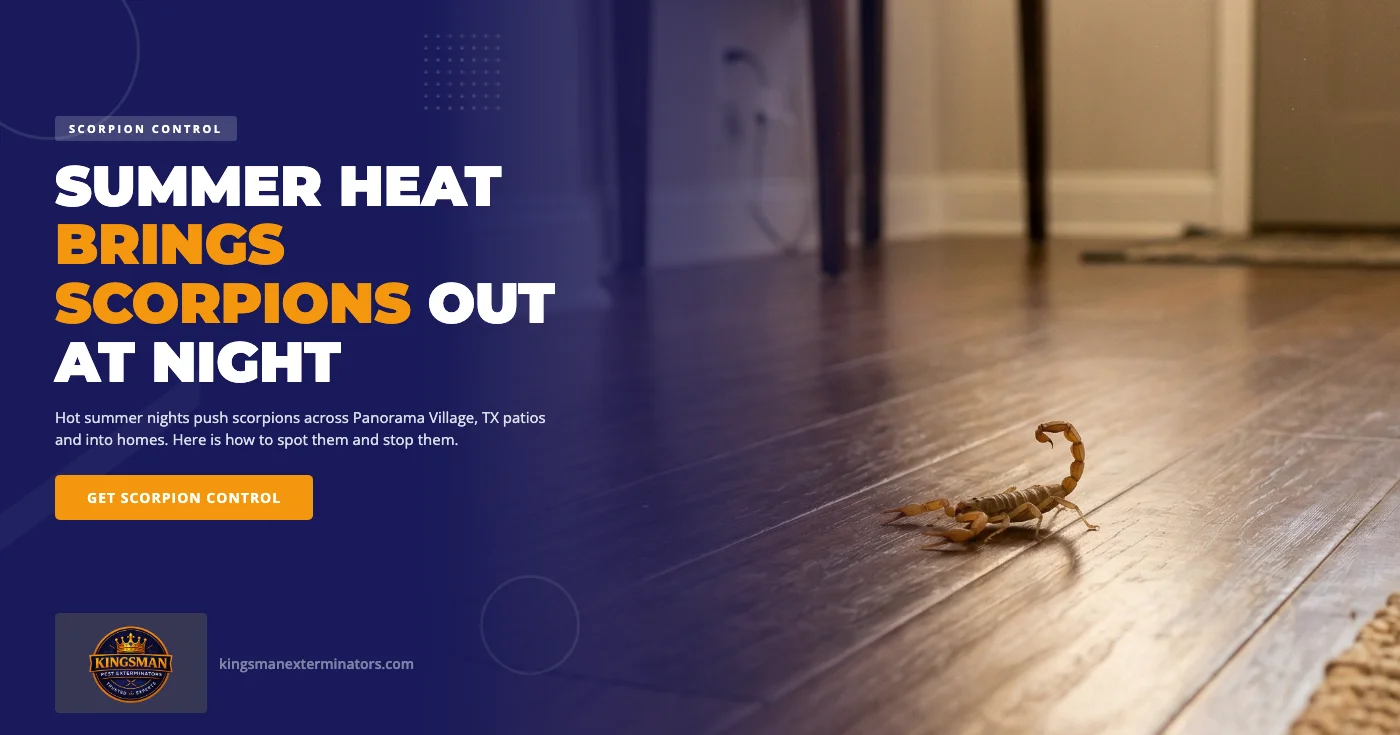
Hot summer nights in Panorama Village, TX have a way of bringing the woods inside. Pine forests give way to neighborhood backyards out here, and once daytime highs settle into the upper 90s, the things that live in that woodland edge start looking for somewhere cooler and damper to spend the night. Scorpions are near the top of that list. At Kingsman Pest Exterminators, we get the same call almost every June, July, and August — a porch light switched on, a glance down at the slab, and a flat little arachnid scuttling toward the door. If that sounds familiar, here is what is actually happening in your yard after dark, and how we keep these visitors out of Panorama Village homes for good.
Why Panorama Village, TX Sees More Scorpion Activity in Summer
Panorama Village sits inside Montgomery County, tucked against the Sam Houston National Forest with pine flats, sandy loam, and stretches of dense vegetation on nearly every side. That landscape happens to be textbook habitat for the striped bark scorpion (Centruroides vittatus), the species that accounts for almost every scorpion call we run in our service area. Texas A&M AgriLife Extension lists East Texas pine forests as primary habitat for this species, alongside rocky slopes and grasslands. In other words, the scorpions did not move into your neighborhood — your neighborhood was built into theirs.
Summer changes the equation in two specific ways. First, scorpions are nocturnal, and they manage both their body temperature and their water balance by hiding during the day and foraging once the sun goes down. When daytime soil temperatures climb high enough to dry out their daytime refuges under stones, logs, and leaf litter, they push deeper into shaded structures — and that often means crawl spaces, slab edges, garages, and attics on the homes that border the woods. Second, the same heat that drives them to relocate also drives their prey indoors. Crickets, roaches, and small beetles concentrate around bright porch lights and irrigated landscaping, and scorpions follow the food.
Wizzie Brown, an entomologist with Texas AgriLife Extension, has noted that scorpions "don't seem to like either very cold or very hot temperatures" and that hot, dry stretches push them toward houses in search of cooler air and water (AgriLife Today). That pattern lines up exactly with the call volume we see across The Woodlands, Conroe, Willis, Montgomery, and Panorama Village from late May through early September.
Where Scorpions Hide Inside and Around Your Home
One of the reasons scorpions catch homeowners off guard is that they are flat — really flat. A mature striped bark scorpion can compress its body to slip through a gap roughly the width of a credit card. Pair that with the species' strong tendency to climb, and the list of likely hiding spots gets long fast.
Outdoors in Panorama Village yards, we routinely find them under landscape boulders, beneath stacked firewood, inside hollow PVC stubs left from old irrigation, in folds of tarps, under flowerpots, and tucked into the dead pine straw that piles up against foundations. Areas of dead vegetation, fallen logs, and human dwellings carry a "distinct association" with this species, according to the Texas A&M field guide.
Indoors, the most common spots we discover during a night inspection are:
- Attic spaces, especially near soffit vents and around recessed-light boxes
- Garage corners, baseboards, and the inside lip of the garage door
- Bathrooms — behind toilets and under vanities, where condensation collects
- Closets on exterior walls, particularly along the floor line
- Shoes, boots, and folded towels left on the floor overnight
One detail that helps us a lot during after-dark inspections: striped bark scorpions fluoresce blue-green under ultraviolet light. We carry UV flashlights on every scorpion call so we can spot live activity in attics, around the foundation, and through landscape beds. It is a tool worth keeping in your own garage if you suspect activity inside the house.
Are Scorpions in Montgomery County, TX Dangerous?
The honest answer: a sting hurts, but the risk profile for a typical adult is moderate. The Texas A&M AgriLife field guide describes the local reaction as painful swelling, numbness, discoloration, and itching that may persist for several minutes to several days. Importantly, the same source states plainly that "there are no scorpions in Texas that are considered lethal to man." The striped bark scorpion is venomous, but its sting is not in the same category as the Arizona bark scorpion that ranges through the Sonoran Desert.
That said, we always tell families in our service area to take the same sensible precautions you would take with any stinging insect:
- Small children, older adults, and anyone with insect-sting allergies should be watched closely after a sting. Any sign of widespread swelling, difficulty breathing, or systemic reaction is an emergency-room call.
- Pets usually react with local pain and a swollen paw or face. If a dog or cat shows lethargy, vomiting, drooling, or labored breathing, contact your veterinarian quickly.
- Healthy adults can typically manage a sting with ice, an antihistamine, and over-the-counter pain relief.
The bigger problem is not a single sting — it is the population pressure. One scorpion inside the house in July almost always means more in the attic, the wall voids, or the perimeter beds. Treating the property as a system is what actually solves the issue.
5 Ways Homeowners Accidentally Attract Scorpions
Most of the scorpion-heavy homes we walk into share four or five habits that quietly roll out the welcome mat. Fixing these does not replace a professional treatment, but it removes the conditions that make a property attractive in the first place.
- Bright exterior lighting in summer. White porch lights, garage floodlights, and pool deck spots pull in crickets, roaches, and moths by the hundreds. Scorpions follow that food source straight to your foundation. Swap white bulbs for yellow "bug" LEDs, or put exterior lighting on motion sensors instead of dusk-to-dawn timers.
- Mulch piled high against the foundation. Pine bark mulch holds moisture, attracts insects, and gives scorpions a daytime hiding layer two inches from the slab. Keep mulch trimmed back six inches from the foundation and rake it shallow.
- Firewood and yard debris stored next to the house. Stacked wood, scrap lumber, garden hoses, and old planters create perfect daytime shelter. Move firewood at least 20 feet from the structure and elevate it off the ground.
- Unsealed weep holes, AC line penetrations, and garage door gaps. Weep holes in brick veneer are required for drainage, but they are also a highway for scorpions. Steel wool or copper mesh inserts let water out and keep arachnids out — a fix the AgriLife Extension Service specifically recommends.
- Sprinkler heads spraying the slab. Constant moisture against the foundation is a beacon. Adjust irrigation so spray patterns stop short of the structure, and fix any leaking exterior spigots.
Professional Scorpion Control Steps That Actually Work in Texas
DIY sprays from the home center can knock down whatever is on the floor at the moment, but they will not break the cycle. The reason: scorpions live in voids and travel along the perimeter, not on the open floor. A treatment program built for Texas conditions has to address the property the way the scorpions actually use it.
Here is the framework our team follows on a typical Panorama Village scorpion job:
- Perimeter barrier treatment with a labeled residual product applied to the foundation, weep holes, door thresholds, and the first few feet of soil and turf around the structure.
- Granular treatment through landscape beds, mulched areas, and along fence lines where harborage and prey concentrate.
- Crack-and-crevice work at weep holes, expansion joints, AC penetrations, plumbing lines, and the garage door seal — the exact pinch points scorpions use to enter.
- Interior treatment in garages, utility rooms, and bathrooms when activity is already inside, with a focus on baseboards and wall voids rather than open floor space.
- Attic treatment for homes that have shown attic activity, since the species climbs aggressively and shelters there well into fall.
- UV night inspections on the first visit and on recheck visits, so we can confirm what is alive on the property tonight — not what was alive last week.
- Quarterly maintenance to keep the perimeter barrier intact. Scorpions live three to five years; a one-shot treatment will not hold them out through the next summer.
Our team is licensed, insured, and background-checked, and our treatments are eco-friendly and gentle around pets, with low-impact products selected for North Houston conditions. If you want to compare scope across our full lineup, our Pest Services page lays out each program.
When to Call Kingsman Pest Exterminators for Help
If you have seen even one scorpion inside the house this summer, that is the moment to call. Waiting until you see two or three usually means the population has already established. We offer same-day or next-day service across Panorama Village, The Woodlands, Spring, Conroe, Willis, Montgomery, Magnolia, Oak Ridge North, Shenandoah, Tomball, and Porter, and every program we run is backed by our 100% Satisfaction Guarantee — if scorpions come back inside between scheduled visits, we re-treat at no extra cost.
As a locally owned and operated team based in The Woodlands, we know how Montgomery County properties behave in the heat: which subdivisions sit on sandier soil, which builders left larger weep holes, which neighborhoods back up to wooded greenbelts that act as scorpion highways. That local context is the difference between a treatment that lasts and a treatment that fades by the next full moon.
Frequently Asked Questions
What month do scorpions become a problem in Panorama Village, TX?
Activity ramps up in May, peaks in July and August, and stays elevated through September. Cooler, wetter Septembers can extend the season by a few weeks; dry, hot ones cut it short.
Do scorpions in Texas really glow under UV light?
Yes. The cuticle of the striped bark scorpion fluoresces blue-green under ultraviolet light. A handheld UV flashlight is one of the best DIY tools for spotting them at night in attics, baseboards, and along the foundation.
Should I try to kill a scorpion myself or call a professional?
If you see one, a heavy shoe or a long-handled tool works fine for the immediate problem — keep your hands clear and the body in view. The reason to call a professional is the population behind it: where there is one striped bark scorpion in July, there are almost always more nearby in voids and landscape.
Will one treatment fix a scorpion problem?
Rarely. Striped bark scorpions live for years and travel along the same perimeter routes generation after generation. Our quarterly maintenance program is built to keep the barrier intact season over season, which is what actually solves the issue long term.
Are your treatments gentle around pets and children?
Yes. Our products are eco-friendly, lower-impact, and applied by licensed, insured technicians who focus residuals at perimeter pinch points rather than open living space.
If summer scorpions have started showing up around the slab, in the garage, or inside the house, our team is ready to help. Visit our Pest Services page to see how a Panorama Village treatment program is built — and let us put a guaranteed, locally proven barrier between your family and Montgomery County's most stubborn nighttime visitor.