
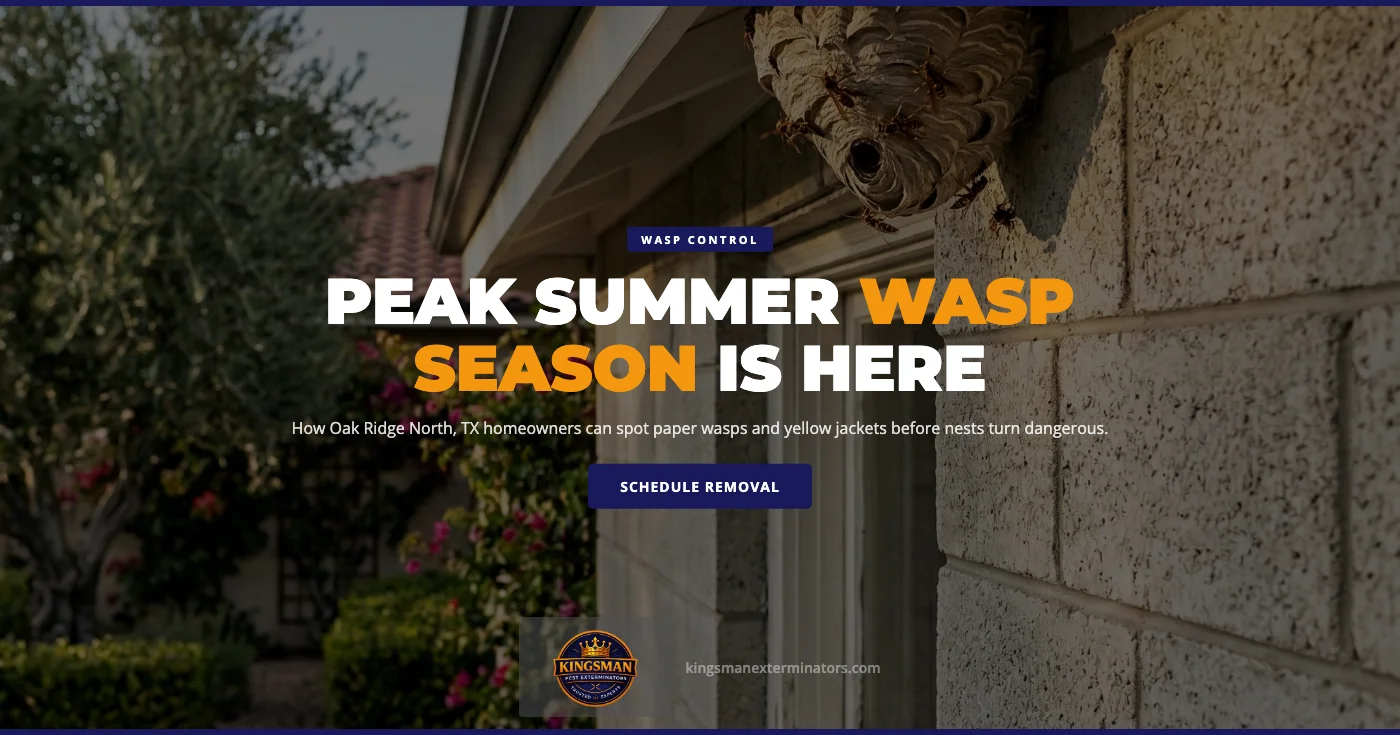
We have been running wasp calls across Oak Ridge North, TX all summer, and July is when things really turn. The starter nests we removed under eaves in May are now full colonies — dozens of workers on paper wasp combs and thousands on hidden yellow jacket nests. This is the moment every year when a nest that looked like nothing in June becomes the reason a family cannot use the back patio.
If you have noticed more wasp traffic around your porch, insects streaming in and out of a single hole in the ground, or a large paper comb tucked under a soffit, you are seeing the peak of Southeast Texas wasp season. As the local team that handles wasp control in Oak Ridge North, TX, we will walk through why activity spikes now, how to tell the three most common species apart, and when a nest crosses the line from nuisance to genuine hazard.
Why Wasp Activity Peaks in Oak Ridge North, TX During Mid-Summer
Wasp season in Southeast Texas is longer than in most of the country, but it is not steady. Colonies build slowly through the spring, ramp up sharply in June and July, and hit their most defensive, most populous state from mid-July through September. Two things drive the peak in Oak Ridge North: heat and food pressure.
Late-summer Gulf Coast weather turns Montgomery County into an insect factory. Persistent 90-degree afternoons, high humidity, and heavy tree cover across the I-45 corridor give paper wasps and yellow jackets everything they need — wood fiber for nest expansion, water pooling in irrigation zones, and abundant insect prey. The Texas A&M AgriLife extension guide to paper wasps, yellowjackets, and solitary wasps notes that colonies grow throughout summer until food resources decline, at which point workers become dramatically more aggressive.
By mid-July in Oak Ridge North, a paper wasp nest that started with a single queen in April holds 20 to 30 workers. A yellow jacket colony almost invisible in May can hold several thousand workers by August. Every worker can sting, every worker defends the nest, and the trigger distance shrinks by the week.
Yellow Jackets, Paper Wasps, and Mud Daubers: How to Tell Them Apart
Three groups drive the vast majority of the summer nest calls we run in Oak Ridge North and across North Houston. Correct ID matters because the risk profile, nest location, and treatment approach are different for each.
Paper wasps (Polistes species). Slender, long-legged wasps about an inch long. In Southeast Texas, the most common species is the reddish-brown Polistes carolina — the red wasp — along with the brown-and-yellow Polistes exclamans. The Texas A&M field guide to paper wasps describes their nests as open, umbrella-shaped combs of hexagonal cells hanging from a single stalk, usually under eaves, porch ceilings, and patio covers. You can see the cells and the wasps working on them — there is no papery envelope.
Yellow jackets (Vespula and Dolichovespula species). Stockier than paper wasps, closer to honey-bee size (about half an inch), with sharp black-and-yellow striping and no hair. Unlike paper wasps, yellow jacket nests are enclosed inside a papery envelope with a single small entrance hole. Most nests around Oak Ridge North, TX are underground — in old rodent burrows, along foundation lines, or inside wall voids — but they also nest in irrigation boxes, water-meter housings, and attics. Southern yellow jacket colonies commonly reach several thousand workers by late summer, according to the Texas A&M field guide to southern yellowjackets, and defending workers can inflict multiple stings.
Mud daubers. Long, thin, black or metallic blue wasps that build tubular mud tubes on stucco walls, garage door tracks, and shed ceilings. They are solitary and rarely sting unless grabbed — but their abandoned tubes often become nesting sites for more aggressive species the following season, so we still remove them during a wasp visit.
Where Wasp Nests Typically Form Around Southeast Texas Homes
By July, nests are no longer subtle. Workers are actively coming and going, expanding the comb, and defending the perimeter. When our technicians inspect an Oak Ridge North property in the middle of summer, these are the spots that consistently produce active nests:
- Under eaves, soffits, and roof overhangs — the classic paper wasp real estate. Shaded north- and east-facing sides of the home get hit first.
- Attic gable and ridge vents — both paper wasps and yellow jackets exploit torn screens or gapped vent housings.
- Porch ceilings, pergolas, and patio covers — high-traffic sting zones because homeowners walk right underneath.
- Playsets, swing-set tubes, and trampoline frames — a serious hazard for kids in Oak Ridge North backyards.
- Ground burrows near flower beds, tree bases, and irrigation lines — yellow jacket signature. Watch for a stream of insects entering and leaving the same small hole.
- Wall voids, water-meter boxes, irrigation control valves, and AC disconnect panels — hidden yellow jacket colonies that only reveal themselves once dozens of workers are circulating.
- Grill covers, patio storage benches, and outdoor furniture cushions — surprisingly common for late-stage paper wasp expansion.
- Garage door tracks, mailboxes, and light fixtures — small dark cavities that support both mud daubers and paper wasps.
Homes in Oak Ridge North with mature oaks and dense landscaping almost always host more than one nest at peak season. It is common for us to clear three or four active nests during a single mid-summer visit.
Why DIY Wasp Nest Removal Can Turn Dangerous Fast
We understand the impulse. The nest is right there, you have a can of hardware-store spray, and you would rather not wait. But by mid-July, a wasp nest is nothing like the five-cell starter you might have handled in April. Every DIY removal at this stage carries real risk.
The first problem is the wasps. Unlike honey bees, wasps can sting repeatedly. The Texas A&M paper wasp guide is blunt: paper wasps "attack when the nest is disturbed and each can sting repeatedly," and yellow jacket workers respond with even greater aggression. A single disturbed ground nest in Oak Ridge North can release dozens of defenders within seconds, and homeowners frequently trigger a hidden second nest they never knew was there.
The second problem is location. Most peak-season stings we hear about in Montgomery County did not happen at the nest — they happened on the ladder or roof, or during the awkward twist a homeowner made trying to spray a nest tucked behind a shutter. Losing balance while under attack is how wasp calls end at the emergency room.
The third problem is the queen. Aerosol contact sprays kill visible workers but rarely reach the queen and developing brood deep in the comb. Within days, surviving workers regroup and rebuild a few feet from the original spot. Professional treatment injects a low-toxicity product directly into the comb so the entire colony — queen included — is neutralized in one pass, followed by pest exclusion around vents and soffits to keep the next queen from moving in.
What to Do If a Family Member Is Stung
Wasp stings are painful, but most reactions are localized and manageable at home. Following the guidance published by the Children's Hospital of Philadelphia Poison Control Center, the standard first-aid steps are straightforward:
- Move away from the nest. Wasps release alarm pheromones that recruit more attackers — get inside or well clear before treating the sting.
- Wash the area with soap and water. Reduces the risk of secondary infection.
- Apply ice for 15 minutes on, 15 minutes off. Controls swelling and pain.
- Consider an oral antihistamine and an over-the-counter pain reliever for itching and discomfort.
- Do not squeeze at the sting site. Wasp stingers are usually not left behind, but if one is, scrape it out with the edge of a credit card rather than pinching.
Some reactions cross into medical emergency territory. Call 911 immediately if the person stung shows any of the anaphylaxis warning signs the Children's Hospital of Philadelphia lists: difficulty breathing or wheezing, swelling of the face or neck, tightness in the throat, or loss of consciousness. Symptoms can develop within 30 minutes of a sting. If someone in the household carries an epinephrine auto-injector, use it at the first sign of a serious reaction and call 911 anyway. Multiple stings — especially from a yellow jacket ground nest — warrant an urgent-care visit even for people with no known allergy.
When to Call a Professional Wasp Removal Service in Oak Ridge North
Not every wasp sighting needs a technician on the property. A single mud dauber tube on the side of the garage is generally not a threat and can be knocked down once activity stops in the fall. A paper wasp nest visibly bigger than a golf ball, a ground hole with steady traffic, or any nest within stinging distance of a door, walkway, playset, or grill is a different story — those are the calls we prioritize during peak season.
When you reach out for wasp removal in Oak Ridge North, TX, our licensed, insured, background-checked technicians start with a full property inspection — not just the nest you spotted. It is common for a Montgomery County home to have two or three active nests in July. We clear each one with a low-toxicity product formulated for stinging insects, physically remove the comb once the colony is down, and apply a residual treatment to eaves, soffits, and gable vents so returning queens do not rebuild.
Every wasp treatment is backed by our 100% Satisfaction Guarantee with free re-treatments: if activity returns between scheduled visits, we come back at no charge. Same-day and next-day appointments are typically available across Oak Ridge North, Shenandoah, The Woodlands, Spring, and the rest of North Houston.
Frequently Asked Questions About Peak Summer Wasps in Oak Ridge North, TX
When is wasp season worst in Oak Ridge North, TX?
Mid-July through September is the worst window. Colonies have reached peak population, food resources start to tighten, and workers become dramatically more defensive of the nest. In Southeast Texas, wasp activity often stays elevated into October before cool nights finally shut it down.
How do I tell a paper wasp nest from a yellow jacket nest?
Paper wasp nests are open, umbrella-shaped combs where you can see individual hexagonal cells — usually under eaves, porch ceilings, or patio covers. Yellow jacket nests are wrapped in a papery envelope with one small entrance hole, most often in the ground, in wall voids, or inside utility boxes. Visible cells means paper wasp; a stream of wasps flying in and out of one hole means yellow jacket.
Is DIY wasp removal really that dangerous in Southeast Texas?
By peak season, yes. Paper wasps and yellow jackets in Montgomery County are at their most defensive and most populous state right now, and stings are rarely limited to one. The bigger risk in most Oak Ridge North yards is falling off a ladder while under attack — that is what turns DIY into an ER visit.
How big can a yellow jacket colony get in Southeast Texas?
Southern yellow jacket colonies in Texas commonly reach several thousand workers by late summer, and Texas A&M documents nests occasionally surviving multiple years and growing significantly larger than the annual norm. Even a modest ground nest holds enough workers to overwhelm a homeowner within seconds if disturbed.
Get Local Wasp Help Before the Late-Summer Peak
If wasp activity around your Oak Ridge North home has ramped up recently, this is the window to handle it — before colonies hit their most defensive state and before an accidental encounter turns into a medical event. Our Kingsman technicians know where nests hide in Montgomery County neighborhoods this month, and we can typically be on site within one business day. Reach out for trusted, eco-friendly wasp nest removal in Oak Ridge North, TX, backed by our 100% Satisfaction Guarantee with free re-treatments.