
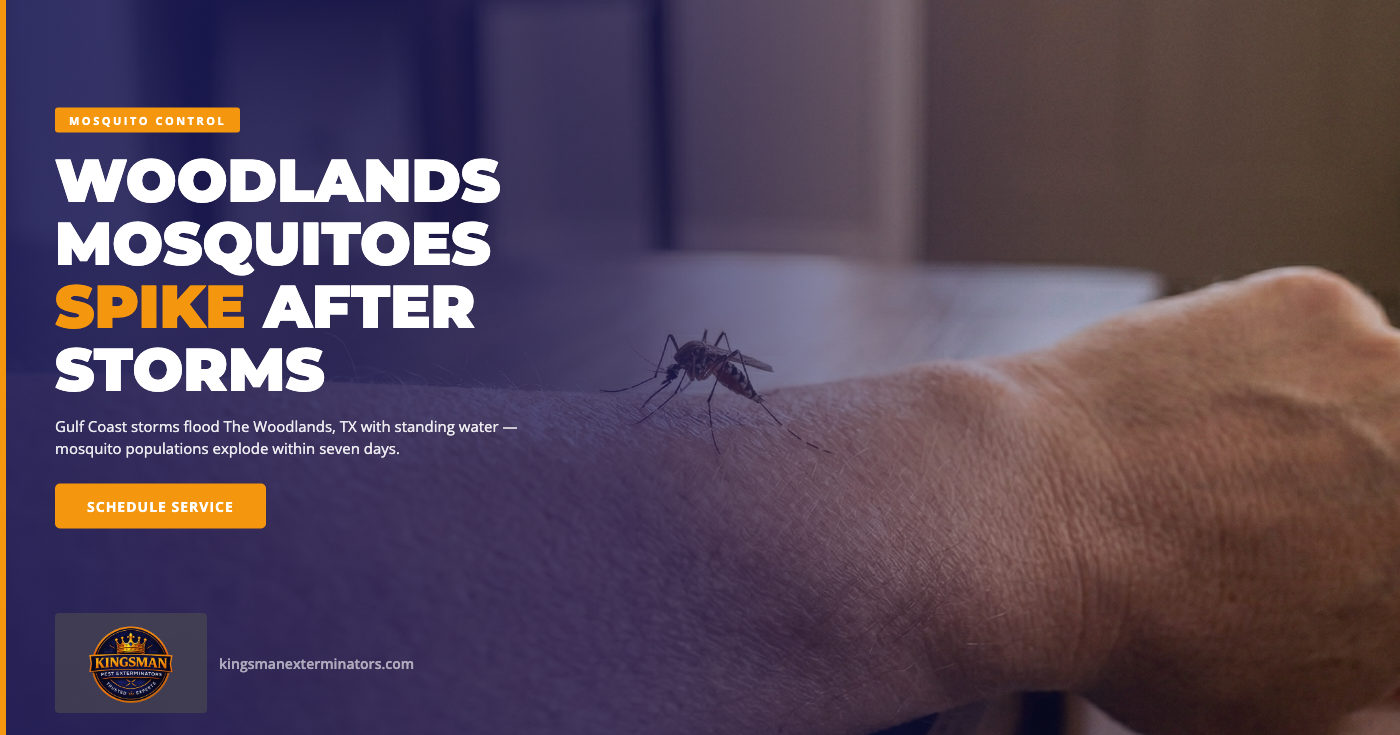
Every time a tropical system rolls up the Gulf Coast and dumps inches of rain across Montgomery County, our phones at Kingsman Pest Exterminators light up within a week. The pattern never changes: heavy rain, a few hot days, and then mosquitoes show up in numbers that turn a backyard barbecue into a sprint for the door. What most homeowners in The Woodlands do not realize is how quickly a forgotten bucket, a clogged French drain, or a sagging tarp becomes a full-blown breeding factory after a storm.
As a locally owned team serving The Woodlands, Spring, Conroe and the rest of North Houston, we spend a lot of our summer chasing post-storm mosquito blooms. This guide covers why storms trigger the spike, how the breeding cycle works, where the water hides, and what to do about it — including when to call a trusted, guaranteed, eco-friendly treatment in.
Why Gulf Coast Storms Trigger Mosquito Booms in The Woodlands
The Woodlands sits in near-perfect mosquito habitat: heavy clay soils that drain slowly, dense tree canopy that holds humidity for days, thousands of acres of green belts and detention ponds, and a climate that rarely cools enough to break the breeding cycle from April through October. Layer a Gulf Coast storm on top and the math gets ugly fast.
A single tropical depression can drop four to eight inches of rain over Montgomery County in a few hours. Most of that water moves on, but a meaningful fraction stays behind in clogged gutters, low spots in St. Augustine lawns, pool covers, recycling bins, and the bottom of every flowerpot on every patio in the neighborhood. The Woodlands Township runs a recurring "Drain After the Rain" reminder every summer for exactly this reason — they ask residents to walk their yards within 24 hours of a storm.
Our local mosquito mix is dominated by two villains. Culex species (the night-biting, West Nile-carrying mosquitoes) love stagnant, organic-rich water like clogged gutters and storm drains. Aedes albopictus, the Asian tiger mosquito, is the aggressive daytime biter that thrives in small artificial containers — a bottle cap of water is enough. Both explode in the warm, humid window after a Gulf Coast storm.
The 7-Day Mosquito Breeding Cycle You Need to Know
Post-storm mosquito control is so urgent because of a single number: seven days. That is roughly how long it takes a fresh mosquito egg in The Woodlands' summer heat to become a biting adult ready to lay the next batch.
Here is what the CDC lays out for the species we deal with locally, in plain English:
- Day 0 — Egg. A female lays 100 to 300 eggs on the inside wall of a container, just above the waterline. Aedes eggs can sit dry for months; Culex eggs hatch within 24 to 48 hours of being submerged.
- Day 1 to 2 — Hatch. Rain or a hose hits those eggs, water rises, and larvae emerge — the wrigglers you see swimming in a bucket.
- Day 2 to 8 — Larva and pupa. Larvae feed for six to eight days through four growth stages, then enter a brief pupal stage.
- Day 7 to 10 — Adult. A new adult emerges, dries off for a few hours, and starts hunting for blood. In our heat, five to seven days is normal.
Break the cycle inside that one-week window and you prevent the entire next generation. Miss it, and one female can become thousands of biting offspring before the month is out.
Standing Water Hotspots Around Your The Woodlands Property
When our team walks a Woodlands property after a storm, we are looking for water that has sat for more than 72 hours. Anything stagnant past that window is a candidate breeding site. Here is where we find it, in roughly the order we find it:
- Clogged gutters and downspouts. Pine needles, oak leaves and pollen are the number-one breeding source we find in The Woodlands. A half-clogged gutter is a 40-foot swimming pool for Culex.
- French drains and yard drains. Heavy clay around Panther Creek and Cochran's Crossing routinely backs up; when the grate sits below the water line for days, the drain becomes the nursery.
- Pool covers and equipment trays. A sagging cover on a perfectly maintained pool can hold ten gallons of rainwater on top.
- Plant saucers and patio pots. The saucer under a single hibiscus can produce a generation every week from June through September.
- Kids' toys, wagons, and sandbox lids. A toy dump truck left upright is a textbook Aedes breeding site.
- Trash and recycling bins. Lids left open fill up fast; the organic residue inside makes the water especially attractive.
- Tarps over boats, grills, and lawn equipment. Any tarp that sags creates a sheltered breeding pocket.
- Tree holes, stumps, and irrigation valve boxes. Easy to miss on a casual walkthrough — we look for these every time.
- Bird baths, fountains and rain barrels. Active water is fine; water that has not moved in a week is not.
- AC condensate drip pans. A blocked condensate line drains into a tray under the unit and breeds mosquitoes that come right back into the house.
If you walked your yard right now, you would almost certainly find three or four of these. After a storm, it is more like six or eight.
How to Eliminate Mosquito Breeding Sites After a Storm
The good news is that a focused, 30-minute walkthrough in the first 48 hours after a Gulf Coast storm prevents most of the next week's biting pressure. Here is the routine we recommend to every homeowner in The Woodlands and across North Houston:
- Dump everything that holds water. Toys, buckets, planters, tarps, wheelbarrows — tip them over and store them inverted or under cover.
- Flush the gutters. Clear pine needles and oak debris. If water pools when you run a hose into the gutter, the slope is wrong and needs adjusting.
- Check drain grates. Pop the lid on French drains and yard drains; if you find standing water, run a hose to confirm the line is flowing.
- Refresh active water. Empty bird baths and pet bowls every two to three days. Add a pump or aerator to decorative ponds.
- Treat the water you cannot drain. Drop a Bti larvicide briquette (mosquito dunk) in rain barrels, fountains, and low spots that will not grade out. Bti is a naturally occurring bacterium that targets mosquito larvae only — it does not harm fish, birds, pets, or pollinators.
- Trim back canopy and ground cover. Adult mosquitoes rest in shaded vegetation during the day; cutting back overgrown shrubs removes the harborage.
- Run a fan on the patio. Mosquitoes are weak flyers and avoid moving air — the easiest evening fix homeowners overlook.
Done consistently, that routine handles most low-pressure Woodlands properties. After back-to-back tropical systems or a stalled-out rainy week, even the best routine cannot keep up — and that is where a professional treatment earns its keep.
When DIY Isn't Enough: Signs You Need Professional Mosquito Control
Most of our mosquito calls in The Woodlands come from homeowners who tried the standing-water checklist and still cannot enjoy their backyard. Here are the signals that the breeding pressure has outrun what a homeowner can manage alone:
- You are getting bitten in the middle of the day. That is Aedes albopictus — there is a productive container source within about 150 yards of where you are standing.
- The bites are heaviest at dusk and dawn. Points to Culex coming out of gutters, storm drains, or a neglected neighbor's property.
- You can hear them. Hearing the whine on the patio means adult populations are well above what DIY sprays will knock down.
- The yard is fine on dry weeks but unusable for ten days after every rain. Classic post-storm pattern — the fix is interrupting the cycle, not more bug spray.
- You back onto a green belt, golf course, retention pond or wooded lot. The breeding source is partially off your property, which means the perimeter has to do more work.
- Higher-risk household members. Babies, elderly relatives, anyone who reacts strongly to bites, or pets that spend long hours outside all raise the bar on acceptable mosquito pressure.
At that point, you need a treatment plan that knocks the existing adult population down quickly and keeps reapplying pressure on the breeding sites week after week. That is what our mosquito control service is built around.
What a Professional Mosquito Treatment Plan Looks Like in The Woodlands
Our team treats mosquitoes the way the science says to: interrupt the cycle in multiple places at once, then come back often enough that the next generation never finishes. Here is what a typical Kingsman Pest Exterminators mosquito plan looks like for a Woodlands property:
- Property walkthrough. We inventory every breeding site — gutters, drains, low spots, containers, tree holes, irrigation valve boxes — and give you a written list of what spray will not fix.
- Larvicide where it counts. Bti briquettes or granules go in every standing-water source we cannot drain. Bti is eco-friendly and only targets mosquito larvae.
- Targeted adulticide on resting sites. A low-toxicity residual treatment goes on the shaded vegetation where adults rest — shrub undersides, fence lines, the underside of the deck. We are treating the harborage, not fogging the open lawn.
- Re-treatment on a 21-to-30-day cycle. That cadence matches the local breeding cycle so the next generation never makes it to biting age.
- Storm-trigger visits. When a tropical system rolls through, we reschedule a re-treatment inside the seven-day window that catches the post-storm hatch before it matures.
- 100% satisfaction guarantee. If mosquito pressure comes back between scheduled visits, we come back and re-treat at no charge — the Kingsman guarantee on every service we run.
Our technicians are licensed, insured and background-checked, and the treatments we use are designed to be gentle around pets, kids and pollinators. Most of our Woodlands clients see a dramatic drop in mosquito pressure inside the first week and full backyard usability within two visits.
Frequently Asked Questions
How fast can mosquitoes breed after a storm in The Woodlands?
In our summer heat, eggs deposited before a Gulf Coast storm hatch within 24 to 48 hours of being submerged, and the larvae mature into biting adults in as little as five to seven days. That is why post-storm complaints almost always land about one week after the rain stops.
Do I have to drain my rain barrel or decorative pond?
No. Any active water source — a pond with a pump, a daily-running fountain, a pond stocked with mosquitofish — is not a breeding risk. For passive sources like rain barrels and birdbaths, refresh the water every two to three days or drop in a Bti mosquito briquette, which targets larvae only and is gentle around birds, pets and pollinators.
How long does a professional mosquito treatment last in North Houston?
Most residual barrier treatments hold for roughly 21 to 30 days. Heavy rain, frequent irrigation and overgrown vegetation can shorten that window, which is why we work on a 21-to-30-day re-treatment cycle and add post-storm visits when tropical systems come through.
Is professional mosquito control eco-friendly around pets and kids?
The treatments we use are low-toxicity formulations applied to harborage vegetation, not to play areas. Bti larvicide is a naturally occurring bacterium that targets only mosquito larvae. We are happy to walk through every product on the label with you before any treatment runs.
How do I get started with Kingsman?
Reach out through our mosquito control page and we will schedule a same-day or next-day walkthrough of your Woodlands property, confirm where the breeding pressure is coming from, and build a treatment plan around how you actually use your yard.