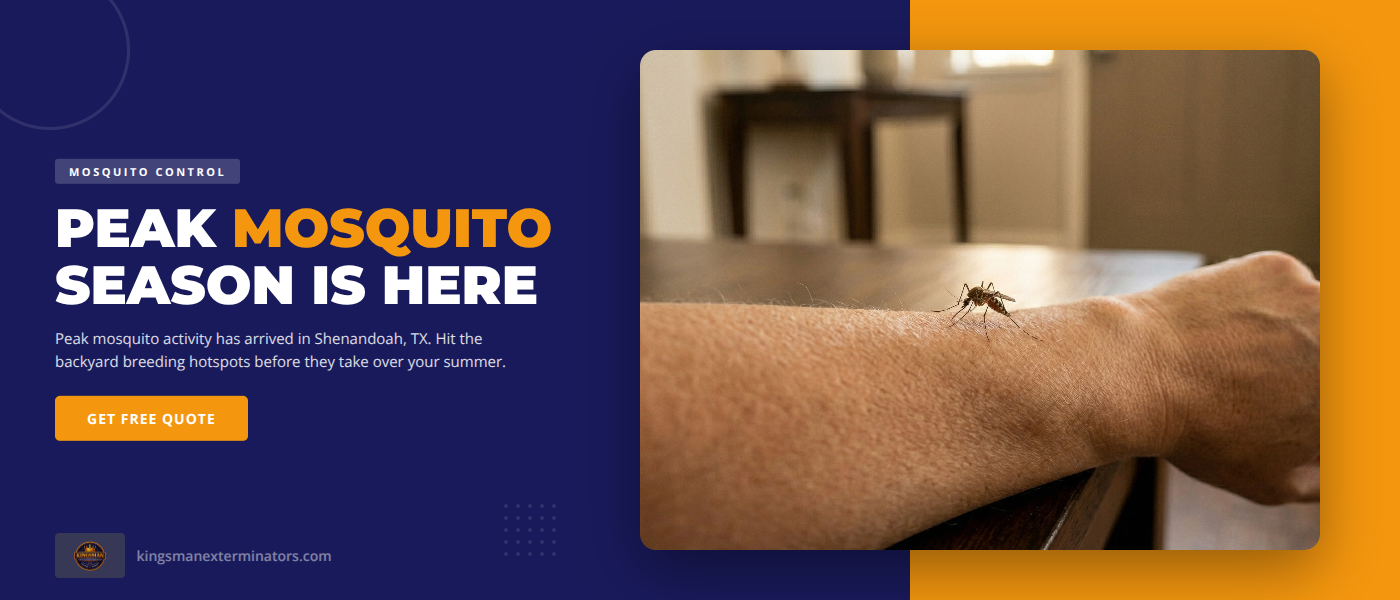
If the first warm, humid evenings of May have already sent you running indoors swatting at your ankles, you are not imagining it. Mosquito season has arrived in Shenandoah, TX, and based on the conditions our team is seeing across Montgomery County this spring, it is shaping up to be a relentless one. Between the Gulf moisture, the recent storms feeding our drainage ditches, and the wooded lots that surround so many of our neighborhoods just off I-45, the conditions for backyard breeding are about as favorable as they get. Below, we walk through why mosquitoes peak here when they do, where they actually breed on your property, what they put your family at risk for, and how we approach mosquito control in Shenandoah, TX at Kingsman Pest Exterminators.
Why Mosquito Activity Peaks in Shenandoah Each May
Shenandoah sits squarely in the Gulf Coast climate belt, which is one of the longest mosquito seasons in the country. While most of the United States deals with mosquitoes for three or four months, our local season often runs from March into November, with activity spiking in May as nighttime temperatures climb past 70 and afternoon storms refill every container, ditch, and low spot on your lot.
The lifecycle is short — under the right conditions, mosquitoes can complete the egg-to-adult cycle in seven to ten days. That means the rain that fell two weekends ago is producing the mosquitoes biting on your patio tonight. May is also when the dominant local species, including Culex quinquefasciatus (the Southern house mosquito) and several Aedes species, begin their first major population surge of the year. Without intervention, that surge feeds every wave through August and September.
For homeowners looking into shenandoah mosquito season patterns, the takeaway is simple: by the time you notice the bites, the next generation is already developing in standing water you have not yet found.
The Top Backyard Breeding Hotspots Around Shenandoah Homes
Most people are surprised to learn how little water a mosquito needs. A bottle cap's worth is enough for some species. When we walk a property in Shenandoah, Oak Ridge North, or Conroe, the mosquito breeding hotspots shenandoah homeowners consistently miss tend to be the same handful of culprits:
- Clogged gutters and downspout extensions. Pine needles from our loblolly canopies build up quickly and dam water for weeks.
- Plant saucers and pot trays. The thin film of water trapped between a pot and its saucer is a perfect nursery.
- Tarps, kayaks, and grill covers. Any folded vinyl or canvas that collects rainwater is a candidate.
- French drains and low spots. If the drain has lost its slope or the outlet is buried, water lingers underground for days.
- Bromeliads and ornamental water features. Beautiful, but the central cups in tropicals and the still edges of fountains both breed mosquitoes if untreated.
- Forgotten kiddie pools, wheelbarrows, and trash can lids. Anything stored open-side-up after a storm.
- Uncapped fence posts and bamboo cuttings. The hollow interior holds just enough water for Aedes eggs.
One thing we want every backyard mosquito treatment texas homeowner to understand: your neighbor's untreated yard matters. Mosquitoes routinely travel 300 feet or more, so a single neglected gutter two houses down can re-seed your property within a week.
Health Risks: West Nile, Zika, and Other Mosquito-Borne Diseases in Southeast Texas
The bites are the obvious nuisance, but the public-health picture is what drives the urgency. According to the Centers for Disease Control and Prevention, West Nile virus is the leading cause of mosquito-borne illness in the continental United States, and Texas consistently ranks among the most affected states. Statewide reporting from Texas DSHS recorded hundreds of West Nile cases and dozens of deaths in recent years, and 2025 saw a national spike of more than 40% above baseline.
Beyond West Nile, the species that thrive in Southeast Texas also transmit Zika, dengue, chikungunya, and St. Louis encephalitis. Most healthy adults who contract West Nile recover quickly, but the small percentage who develop neuroinvasive disease can experience long-lasting neurological effects. The risk profile is highest for children, older adults, pregnant women, and anyone immunocompromised — exactly the people we want enjoying a Shenandoah backyard without a haze of insect repellent.
For our pets, heartworm is the other quiet threat. Heartworm is transmitted exclusively by mosquitoes, and the Gulf Coast carries one of the highest infection rates in the country. Reducing mosquito pressure around your home is one of the most direct ways to protect every member of the household.
5 Steps to Eliminate Mosquito Habitat in Your Shenandoah Yard
Habitat removal is the single most effective DIY action you can take, and it is the foundation of every professional mosquito control program we run. The U.S. Environmental Protection Agency calls this an Integrated Mosquito Management approach — eliminate the source first, then layer in targeted treatment. Here is how to get rid of mosquitoes in shenandoah tx backyard spaces, step by step:
- Walk your property after every rain. Anything holding water 48 hours after the storm needs to be tipped, drained, or fixed. Buckets, toys, planters, tarps — all of it.
- Clean gutters and check downspout outlets. Pine needles and oak catkins clog gutters fast in our area. Make sure water exits at the splash block, not into a buried clog.
- Treat permanent water with larvicide briquettes. Rain barrels, ornamental ponds, low spots that will not drain, and pool covers all benefit from a Bacillus thuringiensis israelensis (Bti) dunk. It targets mosquito larvae and is gentle around pets, fish, and wildlife.
- Trim back dense vegetation. Adult mosquitoes rest on the underside of leaves during the day. Thinning the lowest growth on shrubs and clearing leaf litter reduces the resting habitat they need to survive between meals.
- Run fans on the patio. Mosquitoes are weak fliers. A simple outdoor fan on medium speed is enough to make your seating area effectively unreachable for them during a cookout.
Done consistently, these five steps can knock your local mosquito population down by 50% or more. They will not, however, get you all the way there during peak Gulf Coast season — which is where professional treatment earns its keep.
Why DIY Sprays Fall Short Against Gulf Coast Mosquitoes
We are big believers in homeowner action, but we also see what happens when families try to handle the whole problem with hose-end sprays from the hardware store. The product you buy off the shelf is generally a contact-only pyrethroid in a low concentration. It kills what it touches in the moment you apply it, then degrades quickly under our UV index and humidity. By the time you finish dinner outside, the residual is mostly gone.
Coverage is the other limitation. Mosquitoes do not live on your lawn — they rest in shaded vegetation, under decks, beneath the lip of your fence, and along the underside of your eaves. Hose-end applicators cannot reach those zones with the droplet size and pressure needed to coat the surfaces where mosquitoes actually hide. The result is a temporary knockdown of the few mosquitoes in flight, followed by a fresh wave from untreated harborage within 24 to 48 hours.
That is the gap professional mosquito control in Shenandoah, TX is built to close, and it is the gap our team at Kingsman closes for families across The Woodlands every week.
How Professional Mosquito Control Works at Kingsman
Our mosquito control program is built around two ideas: hit every life stage, and treat the surfaces mosquitoes actually use. When we arrive at a Shenandoah property for the first visit, our licensed technician walks the entire yard with you to identify breeding sources, resting harborage, and any features specific to your lot that need attention — pool equipment areas, drainage easements, French drains, bromeliads, the works.
From there, treatment is layered:
- Larvicide applied to any standing water that cannot be drained. Bti briquettes and water-soluble pouches give us weeks of larval control without disturbing fish, frogs, or pets.
- Targeted barrier mist applied to the underside of leaves, fence lines, deck skirts, ornamental beds, and the shaded vegetation around your patio. This is where the adult mosquitoes rest between feedings — and where the residual product needs to land.
- In2Care or equivalent trap stations available for properties with heavy pressure or recurring rebound between visits. These auto-disseminating stations turn the female mosquito itself into a vector for larvicide, treating breeding sites you cannot find.
Every product we use is EPA-registered, applied at label rate by background-checked technicians, and chosen with pets and pollinators in mind. We avoid treating blooming flowers, time applications around bee activity, and use the lowest-toxicity option that will hold up to our climate. And because we are locally owned in The Woodlands, your follow-up visits are scheduled around your yard's actual rebound rate — not a generic national playbook.
When to Schedule Your First Treatment This Season
The honest answer is: as soon as you start seeing mosquitoes, and ideally before. Effective mosquito control in Shenandoah, TX is built around getting ahead of the curve rather than chasing it. Once a population establishes itself in your yard, every subsequent generation is harder to knock back. We recommend an initial treatment in late April or early May, followed by service every three to four weeks through October. Properties bordering wooded lots, retention ponds, or bayou drainage typically benefit from the shorter interval.
If you are reading this in May and you already have bites, start now. Waiting for "the season to really kick in" is the most expensive thing a Shenandoah homeowner can do — by July you are fighting three overlapping generations instead of one.
Frequently Asked Questions
When does mosquito season start in southeast Texas?
Activity typically picks up in March when overnight temperatures climb above 50°F consistently, then escalates sharply through May. Our peak runs May through September, with measurable activity often continuing into November.
How long does a professional mosquito treatment last?
Our barrier treatments hold up for roughly three to four weeks under normal conditions. Heavy rain events, irrigation hitting treated foliage, and cooler stretches can shorten or extend that window, which is why monthly service is the standard cadence.
Are the products you use gentle around pets and kids?
Yes. We choose low-toxicity, EPA-registered formulations and time the application so treated surfaces dry before re-entry — typically 30 to 60 minutes. We also avoid blooming flowers and adjust around any pollinator habitat you want protected.
Do I really need professional service if I am already eliminating standing water?
Habitat removal alone often reduces pressure by 30 to 50%, which is significant. The remaining mosquitoes — many of them coming in from neighbors and adjacent wooded areas — are the ones that drive most bites. Professional barrier treatment closes that gap.
What is the difference between mosquito control and general pest control?
General pest control targets crawling insects and rodents in and around the structure. Mosquito control is its own service focused on the yard, the resting harborage, and the breeding habitat. Many Shenandoah families bundle the two, but they use different products, different equipment, and different visit cadences.
Reclaim Your Backyard This Season
You should not have to give up May evenings on the patio because the mosquitoes won. If you are ready to talk through a plan for your property — whether that is a one-time event treatment for a graduation party or a full-season program — our team is local, our technicians are background-checked, and every treatment is backed by our satisfaction guarantee with free re-treatments between scheduled visits. Reach out through our mosquito control page and we will get you on the schedule before the next storm rolls through.