
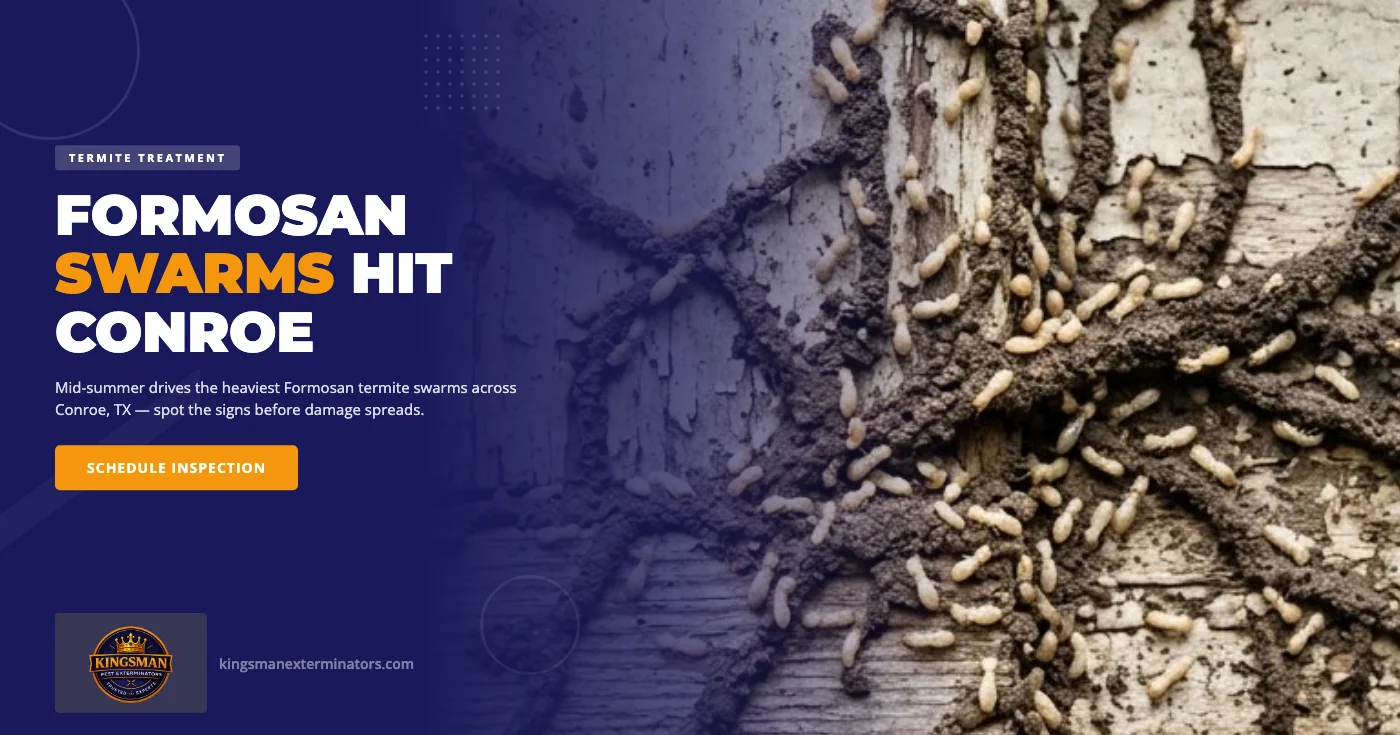
If you live in Conroe, TX and have watched a cloud of winged insects swirl around a porch light on a humid June evening, you may have just witnessed the most destructive termite species in the country in the middle of a dispersal flight. Formosan termites Conroe homeowners contend with every summer are not the slow-and-steady native subterranean termites Texans grew up worrying about — they build colonies several times the size of any native counterpart, and they hit Southeast Texas hardest in the mid-summer window between late May and mid-July.
For Kingsman Pest Exterminators, mid-summer is the busiest stretch of our termite calendar. Formosan termites Conroe residents call us about typically arrive in two waves — a primary swarm in May or early June, then a smaller secondary surge after heavy rain. This guide walks through why Montgomery County draws such heavy Formosan pressure, how Formosans differ from native termites, the warning signs to catch early, and what professional protection looks like during peak swarm season.
Why Conroe, TX Faces a Heavy Formosan Termite Threat
Conroe sits in a humid subtropical climate corridor running from Galveston Bay up through Montgomery County. The conditions that make our summers feel oppressive — dew points in the 70s, soil temperatures in the 80s well into October, frequent thunderstorm activity, and slow-draining clay-rich soils — are exactly what Formosan subterranean termites need to thrive.
The Formosan subterranean termite (Coptotermes formosanus) is not native to the United States. According to the Texas A&M AgriLife Extension Service, the species was introduced into Gulf Coast port cities in the mid-twentieth century and has steadily expanded across Southeast Texas. The Houston metro corridor — Conroe, The Woodlands, Spring — is now one of the most established Formosan zones in the state.
Two local factors compound the threat. Our soils retain moisture long after rain events, so subterranean colonies experience little drought stress even in August. And decades of new construction across Conroe, Willis, and Magnolia have produced thousands of slab-on-grade homes with mulched landscaping pushed up against the foundation — exactly the preferred entry profile for a Formosan colony.
What a Termite Swarm Looks Like Around Your Home
The most visible sign that Formosan termites Conroe homes face are nearby is the dispersal flight itself. A mature colony releases winged reproductives — swarmers — to pair off and start new colonies. A Formosan swarm in Conroe typically unfolds this way:
- Timing: Calm, humid evenings between late May and mid-July, usually within 24 to 72 hours after rain. Swarms begin at dusk and continue into the first hours of full dark.
- Appearance: About 1/2 inch long including wings, with a yellowish-brown to caramel-colored body and two equal-length pairs of translucent wings.
- Behavior: Heavy attraction to porch lights, garage lights, pool lights, and lit windows. Swarmers fly in dense clouds, land on screens and concrete, then shed their wings within minutes.
- Aftermath: Piles of discarded translucent wings on window sills, porches, garage floors, and pool decks the next morning are one of the most reliable signs a Formosan dispersal flight occurred on your property the night before.
Homeowners often mistake termite swarmers for flying ants. Three differences matter: termite antennae are straight (ants' are bent), termite wings are equal length (ants' front wings are larger), and termite bodies have no waist (ants have a pinched waist). A pile of identical translucent wings after a humid Conroe evening is almost always termite.
Subterranean vs. Formosan Termites in Southeast Texas
Native subterranean termites — primarily the Eastern subterranean termite (Reticulitermes flavipes) — have always been present in Southeast Texas. They are destructive, but their colonies are smaller and their swarm windows hit earlier in spring. The Formosan that now overlaps their range across Conroe behaves very differently.
- Colony size: Native subterranean colonies typically range from 60,000 to several hundred thousand workers. Formosan colonies routinely exceed several million workers at maturity.
- Aggression: Formosan soldiers release a milky-white defensive secretion from a forehead gland that native subterranean soldiers do not produce.
- Swarm timing: Native subterranean termites swarm during daylight in February through April. Formosan termites Conroe homes encounter swarm at dusk in late May through July.
- Above-ground nests: Native colonies depend on soil contact for moisture. Formosan colonies can build self-contained, hardened mud nests called cartons inside walls, attics, and tree cavities — which lets them survive even when soil contact is broken.
- Wood consumption rate: A mature Formosan colony consumes wood several times faster than a comparable native colony, simply because there are more workers feeding at once.
The practical takeaway: Formosan infestations move faster, hide better, and survive treatment failures that would otherwise eliminate a native colony. Subterranean termite treatment for a Formosan-infested Conroe home has to be planned around that reality from the first inspection forward.
Damage a Formosan Colony Can Cause in a Single Season
A mature Formosan colony can consume roughly 13 ounces of wood per day — enough to fully consume a foot of 2x4 framing lumber in under a month, and enough to compromise a sill plate, a load-bearing stud, or a floor joist over a crawl space in a single summer.
What that looks like in real Conroe homes:
- Hollowed-out wall studs behind drywall, especially near plumbing penetrations and garage walls.
- Soft, papery floor joists discovered when an HVAC tech steps through a closet floor near a water heater.
- Door frames and window casings that fail under fingertip pressure because the wood has been completely tunneled.
- Above-ground carton nests inside wall voids, often discovered only during renovation or a leak.
- Attic rafters compromised at the eave line where humidity and roof leaks favored a Formosan satellite nest.
National repair-cost figures put U.S. termite damage well above one billion dollars per year, and Formosan colonies are responsible for a disproportionate share — they are the species most capable of significant structural harm in a single season.
Early Warning Signs Conroe Homeowners Often Miss
Most Formosan infestations we treat in Conroe were active for months before the homeowner noticed anything. The earliest signs are subtle and easy to dismiss:
- Discarded wings on window sills, porches, and pool decks. The single most reliable early indicator after a humid June evening.
- Mud tubes on foundation walls and pier supports. Pencil-thin earthen tunnels running vertically up exterior walls, slab edges, and garage interiors. Formosan tubes are usually wider and more abundant than native subterranean tubes.
- Hollow-sounding wood on trim, baseboards, and door frames. Tap with a screwdriver handle — a papery tone where wood should sound solid suggests internal tunneling.
- Buckling paint or bubbling drywall. Often misdiagnosed as a roof leak or plumbing leak. Termite moisture inside wall voids mimics both.
- Unexplained clicking or rustling inside walls at night. Disturbed Formosan soldiers tap their heads against tunnel walls as an alarm signal — sometimes the first thing a homeowner notices.
Any one of these signs on a Conroe property in the May-through-July window is enough reason to schedule an inspection. Formosan colonies do not retreat on their own.
How to Protect Your Property During Peak Swarm Window
A protection plan during peak Formosan swarm season has three layers.
Reduce conducive conditions around the structure. We walk the perimeter and identify moisture and wood-to-soil contact that creates easy Formosan entry. Common culprits in Conroe yards: mulched beds piled above the slab line, fence posts in direct contact with siding, firewood stacked against the foundation, irrigation heads spraying the exterior wall, and AC condensate lines dripping at the foundation.
Install a continuous termiticide treatment around the structure. For existing homes, this typically means a liquid soil treatment around the full perimeter, into the soil along plumbing penetrations and expansion joints, and at identified Formosan entry points. We use modern non-repellent termiticides that transfer through the colony rather than driving termites elsewhere. For homes already showing signs of activity, our termite treatment program also includes targeted spot treatments at active galleries and an inspection schedule sized to the property.
Build protection in before the slab is poured. For Conroe homeowners building a new home or major addition, a pre-treatment protects the structure from the day construction starts. The slab and surrounding soil are treated with termiticide before pour, then again at backfill. A properly executed pre-construction termite treatment is one of the most cost-efficient termite-protection decisions a Texas homeowner can make and is significantly less expensive than retrofitting protection after a Formosan colony establishes inside the structure.
The U.S. Environmental Protection Agency notes that integrated termite management — combining moisture control, structural modification, and properly applied termiticide — is more effective and more durable than any single treatment used in isolation. That same principle drives how we build termite protection plans for Conroe homes.
Frequently Asked Questions About Formosan Termite Swarms in Conroe, TX
What does a Formosan termite swarm look like in Conroe, TX?
A Formosan swarm looks like a dense cloud of yellowish-brown winged insects about half an inch long, swirling around porch and garage lights at dusk on a humid evening between late May and mid-July. The morning after, you typically find piles of identical translucent shed wings on porches, window sills, and pool decks.
How can I tell if termites are swarming in my Conroe, TX home?
Watch for large numbers of winged insects gathering around exterior lights at dusk, swarmers crawling on the inside of windows trying to reach light, and piles of discarded wings the next morning. Wings found indoors on a window sill or near a baseboard often mean the swarm originated inside a wall void — a sign of an established interior infestation that needs immediate inspection.
Are Formosan termites worse than native subterranean termites in Texas?
Yes. Formosan colonies are several times larger, the workers consume wood significantly faster, the soldiers are more aggressive, and Formosans can build self-contained above-ground nests that survive when soil contact is broken. Damage rates on a Conroe property with a mature Formosan colony far exceed those of a same-age native subterranean infestation.
Do I still need a termite inspection if I haven't seen swarmers?
Yes — especially in Conroe. Subterranean termite damage typically progresses inside wall voids and below the slab line for months or years before homeowners notice anything. An annual professional inspection during the May-to-July swarm window is the most reliable way to catch Formosan activity early.
Can store-bought termite products handle a Formosan colony?
No. Retail products spot-kill visible insects and do not transfer through a Formosan colony. Effective control requires a perimeter termiticide application, targeted treatment of active galleries, correction of conducive conditions, and follow-up inspections — work that requires licensed application and professional-grade products.
When to Schedule a Professional Termite Inspection
If you have noticed swarmers around the lights of your Conroe home, found shed wings on a porch or window sill, spotted mud tubes on a foundation wall, or simply have not had a professional termite inspection in the last twelve months, mid-summer is the right window to schedule one. Formosan termites Conroe properties contend with right now will not slow down before fall, and every additional week of activity inside a wall void translates into more damage to repair.
Kingsman Pest Exterminators provides licensed, insured termite inspection and treatment across Conroe, The Woodlands, Spring, Montgomery, Willis, Magnolia, and the broader North Houston service area. Our inspections cover the full exterior perimeter, the interior of garages and utility rooms, accessible attic and crawl space areas, and any active conducive conditions on the property. When activity is identified, we document the species, the locations, and the structural risk, then build a treatment plan around the specific home.
Our technicians are background-checked and licensed, our termiticide programs are designed with families and pets in mind, and every Kingsman service is backed by our 100% Satisfaction Guarantee with free re-treatments if pest pressure returns. To schedule a Formosan termite inspection or to ask about pre-construction protection for a new build in Conroe, TX, contact Kingsman Pest Exterminators today.