
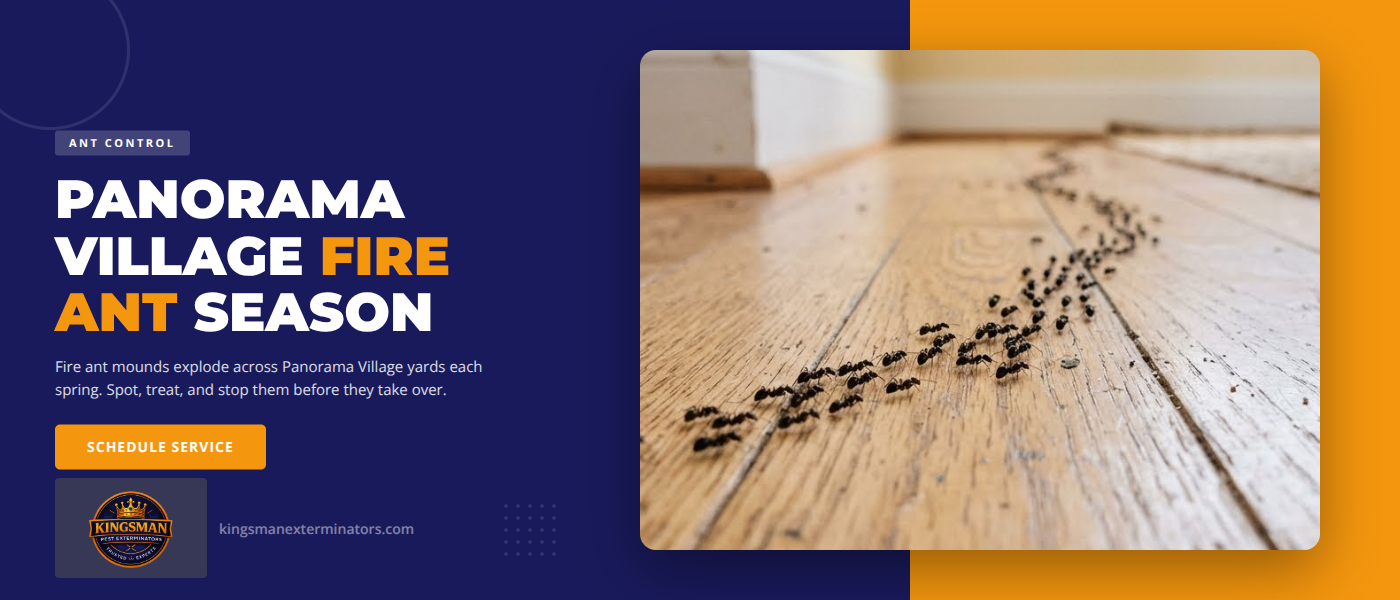
Every spring in Panorama Village, TX, the same scene plays out across yards from Hilltop Lakes Drive to the cul-de-sacs off Liberty Bell: dozens of fresh, fluffy dirt mounds appear seemingly overnight. Step on one and you'll learn quickly that these aren't your average ant hills. Red imported fire ants are back, and Montgomery County is one of their favorite places to set up shop.
At Kingsman Pest Exterminators, we've spent years helping homeowners across The Woodlands, Conroe, and the smaller communities tucked into the piney woods — including Panorama Village — get fire ant populations back under control. Here's what we want every local homeowner to understand before this season's mounds get out of hand.
Why Fire Ant Mounds Surge Across Panorama Village, TX Each Spring
Fire ants don't really go away in winter. They simply move deeper underground to wait out the cold. As soon as soil temperatures climb into the 70s and spring rains soften the ground, the colonies push back to the surface to forage, expand, and produce new queens. In our part of southeast Texas, that surge typically begins in late February and runs hard through May.
Panorama Village sits in a sweet spot for fire ant activity. The community's mix of mature lawns, open green spaces around the golf course, and proximity to the wooded edges of Sam Houston National Forest gives colonies plenty of loose, sandy-loam soil to tunnel through. The frequent spring storms that roll through Montgomery County also play a role — heavy rain forces colonies to push to higher ground, which is why so many mounds seem to appear all at once after a wet weekend.
Established colonies in our area can house 200,000 to 400,000 workers, and a single property often hosts dozens of mounds at peak season. The mounds you see above ground are only a fraction of the story. Beneath each one is a network of tunnels that can extend several feet down and outward.
How to Identify a Fire Ant Mound vs. Other Ant Species in Your Yard
Not every dirt pile in your grass is a fire ant mound, and treating the wrong species wastes time and money. Here's how to tell what you're dealing with.
Fire ant mounds are fluffy, dome-shaped piles of loose soil with no visible central entrance hole at the top. They're often 6 to 18 inches across and can rise 4 to 8 inches above the lawn. The dead giveaway: disturb the mound with a stick and within seconds, hundreds of reddish-brown workers boil out in a coordinated, aggressive defense.
Native Texas ants — pyramid ants, harvester ants, and others — typically build smaller, flatter mounds with a clear central opening. They tend to move slowly when disturbed and rarely sting.
Acrobat ants and crazy ants, both common in Montgomery County, don't build noticeable mounds at all. They nest in mulch, hollow wood, or under landscape stones.
If the workers are 1/8 to 1/4 inch long, reddish-brown on the head and thorax with a darker abdomen, and instantly aggressive when disturbed, you're looking at Solenopsis invicta — the red imported fire ant. That's the one that needs a real treatment plan.
Why DIY Fire Ant Treatments Almost Always Fail
We get calls every spring from frustrated homeowners who have already tried gasoline, boiling water, club soda, grits, instant coffee, or a hardware-store mound drench. Most of these approaches share the same fundamental problem: they kill the workers you can see and miss the queen.
A fire ant colony can survive losing tens of thousands of workers as long as the queen — or in many local colonies, multiple queens — stays alive deep in the tunnel system. Within days, the colony either rebuilds the same mound or simply moves a few feet over and starts a new one. That's why a yard that looked clean on Saturday is often dotted with fresh mounds by the following weekend.
The "boiling water" trick can work on a small, isolated mound if you pour two to three gallons of truly boiling water directly down the center — but it kills surrounding grass and roots, and it only reaches a fraction of the colony. Gasoline and other home remedies are not only ineffective on large colonies, they contaminate the soil and create real environmental problems.
Over-the-counter granular killers can knock down individual mounds, but most homeowners apply them inconsistently or skip the broadcast step entirely. That's the missing piece that separates a quick knockdown from genuine, season-long control.
The Health Risk: Why Fire Ant Stings Are a Real Concern for Families and Pets
Fire ants don't just bite — they bite to hold on, then sting repeatedly, injecting an alkaloid venom that creates the characteristic burning pain (which is where their name comes from). A disturbed mound can deliver dozens or hundreds of stings in seconds, and the resulting pustules can take a week or more to heal.
For most people, fire ant stings are painful but not dangerous. For a small percentage of the population, however, the venom triggers a true allergic reaction — including hives, swelling away from the sting site, difficulty breathing, or anaphylaxis. According to the Texas Imported Fire Ant Research and Management Project at Texas A&M, fire ants sting an estimated 14 million Americans each year, and severe reactions account for emergency room visits across the South every summer.
Pets are particularly vulnerable. Dogs that step into a mound while sniffing around the yard can rack up dozens of stings on their paws and belly before they even realize what's happening. Young puppies, kittens, and small breeds are at the highest risk. We've helped Panorama Village families clear yards after pets had to be rushed to the vet — it's a preventable problem, but only if the colonies are treated before they spread.
Children playing in the grass face the same risk. A toddler who falls on a mound can be stung head to toe in under a minute. For families with young kids, getting fire ant populations under control isn't a cosmetic issue — it's a peace-of-mind issue.
Professional Fire Ant Treatment: Two-Step Method That Actually Works
Texas A&M AgriLife Extension has spent decades testing fire ant control methods, and the approach they recommend statewide is called the Texas Two-Step Method. We use this as the foundation for the fire ant programs we run in Panorama Village and across Montgomery County, layered with adjustments based on what we see in each yard.
Step One — Broadcast bait. A small amount of slow-acting bait is spread across the entire property using a hand-crank spreader. Workers from every colony — including the ones you haven't found yet — pick up the bait and carry it back to feed the queen. Because the bait works slowly, the workers don't realize anything is wrong until it has reached the heart of the nest. Done correctly, broadcast bait reduces overall colony populations 80 to 90% within a few weeks.
Step Two — Individual mound treatment. The largest, most stubborn, or most inconveniently located mounds get a follow-up direct treatment. We use a labeled mound drench or granular product applied right to the colony, which kills the surface workers in one to two days and reaches the brood below. This step handles the mounds you can't afford to wait out — the one next to the patio, the one by the kids' swing set, the one along the front walk.
Done together, these two steps knock down established colonies and prevent the rapid rebound that makes DIY treatments so frustrating. Our local programs typically include a spring kickoff treatment followed by quarterly maintenance visits, which keeps Panorama Village yards essentially mound-free through the active season. Learn more about how we handle ant control as part of a year-round plan.
Preventing New Mounds Through Summer in Montgomery County
Even after a property is cleared, new fire ant queens fly in from surrounding land every spring and summer. A single fertilized queen can start a new colony, and within 12 months that colony can produce a noticeable mound. Prevention is what keeps you from starting over every season.
Here's what we recommend for Panorama Village homeowners between professional treatments:
- Mow regularly and keep edges tidy. Tall grass and overgrown bed lines give new colonies cover to establish before you notice them.
- Reduce moisture sources. Fix leaky outdoor faucets, drain standing water, and avoid overwatering low spots — fire ants love damp soil.
- Clear yard debris. Stacked firewood, leaf piles, and forgotten landscape timbers all make excellent fire ant real estate.
- Inspect after heavy rain. Walk the yard 24 to 48 hours after a storm. Fresh mounds are easiest to spot then, while they're still freshly turned soil.
- Don't disturb suspected mounds. Kicking or mowing over a mound just scatters the workers, who'll rebuild somewhere nearby. Mark it and treat it instead.
Combining these habits with a year-round general pest control plan is the most reliable way to keep fire ants — and the cockroaches, spiders, and wasps that also peak in our area — from taking over the yard.
When to Call Kingsman for Fire Ant Control in Panorama Village
It's time to call us when you've counted more than a handful of mounds across your property, when the same mounds keep coming back after store-bought treatments, when someone in your family has had a stinging incident, or when you simply want the problem handled before it gets worse. We service Panorama Village and the surrounding Montgomery County communities, and our local technicians know exactly how fire ant behavior plays out in southeast Texas soil.
Spring is the best window to get ahead of the season. The earlier we hit the broadcast bait, the fewer mounds you'll see in June and July.
Frequently Asked Questions
How long does it take to get rid of fire ants in a Panorama Village yard?
With the Texas Two-Step Method, most properties see an 80 to 90% reduction in colony activity within two to four weeks of the initial broadcast bait, with individual mound treatments knocking down the largest colonies in one to two days.
Are professional fire ant treatments gentle around pets and kids?
Yes. The bait and mound products we use are EPA-registered for residential properties and are applied in small, targeted amounts. We let homeowners know exactly when it's okay for pets and children to return to the treated areas — usually a short window after application.
Why do fire ant mounds keep coming back after I treat them?
Most home treatments only kill the workers near the surface and miss the queen. As long as the queen survives, the colony rebuilds within days. The broadcast bait step of professional treatment is what reaches and eliminates the queen.
What time of year is best to start fire ant control in southeast Texas?
Spring — typically March through May — is the ideal window because colonies are actively foraging and easy to bait. Fall is a strong second window. Treating early in the season prevents the explosive summer growth that overwhelms most yards by June.
Do I need ongoing treatments or just one visit?
Because new queens fly in from neighboring properties throughout the warm months, ongoing maintenance is the only way to stay ahead of new colonies. Most of our Panorama Village customers are on a quarterly program that combines fire ant control with broader pest prevention.