
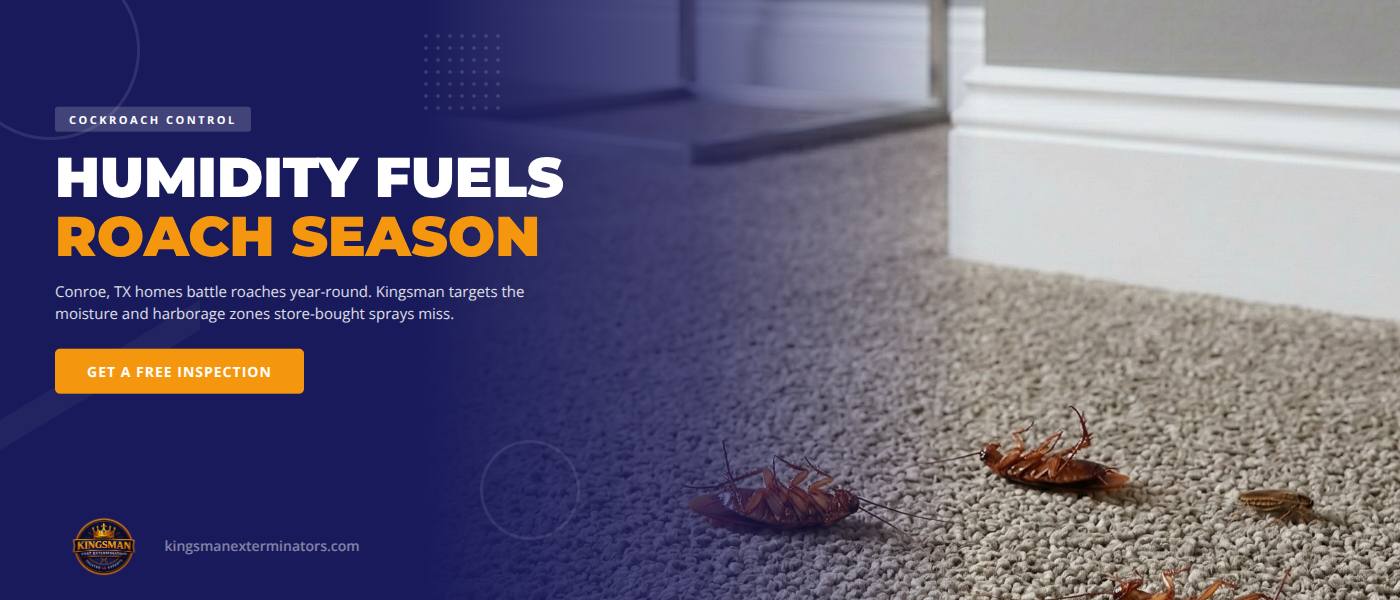
If you live in Conroe, TX and have ever flipped on a kitchen light at midnight to see a roach skitter behind the refrigerator, you already know the problem. Cockroaches are not an occasional Gulf Coast nuisance — they are a year-round reality for almost every home in Montgomery County. Effective cockroach control Conroe TX homeowners can rely on starts with understanding why our local climate makes the area such a productive habitat, and what it takes to push a population back out of a home for good.
Conroe sits in a humid subtropical climate zone with warm soil, mild winters, abundant rainfall, and dew points that climb into the uncomfortable range from May through September. Those four conditions give cockroaches the moisture, warmth, and shelter they need to thrive twelve months a year. Add spring storms that drive outdoor populations indoors and the dense suburban housing stock across Conroe and the broader Montgomery County corridor, and the pressure on local homes is high every season.
This guide covers why cockroach control Conroe TX homes need is year-round work, the species we find, how humidity and storms fuel infestations, where roaches hide, the health risks they bring, why store-bought sprays fail, and when to call Kingsman.
Why Conroe, TX Homes Are Vulnerable to Cockroaches Year-Round
Many homeowners assume pest activity is seasonal — that pests retreat in winter and surge back in summer. With cockroaches in Conroe, TX, that assumption is wrong. The climate here keeps roach populations active in every month of the calendar.
Conroe averages around 50 inches of rainfall per year, and average lows rarely drop below the mid-40s even in January. The soil under and around your home stays workable for cockroach harborage essentially year-round. Indoor environments — kitchens, laundry rooms, garages, water heater closets — stay even warmer and more stable than the outdoors, which is why infestations that begin outside almost always move inside as colonies mature.
The housing stock adds to the pressure. Homes built on slabs with attached garages, pier-and-beam construction in older neighborhoods, and the dense pine canopy across Montgomery County all create the moist, shaded perimeter conditions roaches prefer. Mulched landscape beds against the foundation, AC condensate lines, and organic debris under live oaks and pines combine into one continuous outdoor harborage. From there, any small gap — a worn weather strip, an unsealed utility penetration, a kitchen vent — gives a foraging roach a path inside.
The Most Common Cockroach Species Found in East Texas Homes
When we inspect Conroe, TX homes for cockroach activity, we typically encounter four species. Identifying which species is driving an infestation matters because the harborage and treatment approach differ for each.
- German cockroach (Blattella germanica): The most common indoor cockroach in Conroe, TX kitchens and bathrooms. Small, light brown, with two dark stripes behind the head. German roaches breed faster than any other species — a single egg case carries 30 to 40 eggs. Once established, a German population will not resolve without a coordinated cockroach control program.
- American cockroach (Periplaneta americana): The large, reddish-brown roach most Conroe homeowners call a "palmetto bug." Adults can exceed 1.5 inches. Americans prefer warm, humid voids — sewers, storm drains, crawl spaces, water heater closets — and enter homes through plumbing penetrations and garage gaps.
- Smokybrown cockroach (Periplaneta fuliginosa): A close relative of the American roach, widespread across the Gulf Coast. Smokybrowns are heavily moisture-dependent and common around Conroe's wooded lots, tree-line gutters, and attic spaces with humidity issues.
- Oriental cockroach (Blatta orientalis): Less common but present in Conroe, TX. Dark, almost black, and slow-moving. Orientals favor cool, damp areas — drains and exterior plumbing access points.
The Texas climate also supports the Turkistan cockroach in newer developments where it has displaced Oriental populations. Knowing which species is active on a property changes the inspection map and the treatment strategy entirely.
How Humidity, Heat, and Spring Storms Fuel Cockroach Activity
Cockroaches need three things to maintain a thriving population: warmth, moisture, and a reliable food source. Conroe, TX delivers all three at intensities most regions never reach. The summer months from May through September feel uncomfortably humid because dew points routinely sit above 65°F, and that surface moisture is exactly what roach populations require for optimal reproduction. The American cockroach reproduces fastest at temperatures around 80°F with high relative humidity — a profile that describes a Conroe summer almost perfectly.
Spring storms add a second pressure. When heavy rain saturates the soil and floods the storm drain system, populations of American and smokybrown roaches living in drains, sewer lines, and tree cavities are forced upward and outward. Conroe, TX homeowners commonly report a surge of large roaches inside the home during and after spring rain events. The roaches are evacuating saturated outdoor harborage, and any home with gaps around plumbing, garage doors, or weep holes becomes a refuge.
Heat extends the active season. Cockroaches expand their activity radius in summer, moving from outdoor harborage into shaded, moist interior voids in search of cooler microclimates. The kitchen sink, the dishwasher cavity, and the back of the refrigerator stay between 75°F and 85°F nearly year-round, which is why kitchen-centered German cockroach populations are so persistent in Conroe homes.
Where Cockroaches Hide Inside Conroe Properties
One reason Conroe, TX homeowners underestimate a cockroach problem is that the visible insects represent a small fraction of the actual population. Roaches are nocturnal and prefer tight, dark spaces where their bodies press against surfaces. By the time you are seeing them in daylight or in numbers, the harborage has already saturated.
The most common interior harborage areas we identify during cockroach control inspections in Conroe, TX homes:
- Behind and beneath kitchen appliances: Refrigerator motor compartments, the cavity beneath dishwashers, the void behind ranges, and microwave electronics. Heat plus food debris equals ideal German cockroach habitat.
- Inside cabinets and drawer rails: Particularly under-sink cabinets where plumbing penetrates the floor. Slow leaks at supply lines or P-traps create exactly the moist conditions roaches need.
- Water heater closets and laundry rooms: Warm, often humid, and frequently overlooked during routine cleaning. We find established American and smokybrown harborage in these areas regularly.
- Attached garages: Garages often store recycling, pet food, and seasonal items — all reliable food sources. Garage door weather seals and the slab expansion gap give roaches direct access from the exterior.
- Attics and wall voids: Smokybrowns travel through attic spaces, especially in homes with humidity issues or inadequate ventilation. Wall voids around plumbing chases provide vertical travel routes between floors.
- Storm drains and irrigation boxes outside the home: The exterior reservoir that keeps re-supplying interior populations. Treatment that ignores exterior harborage almost always fails within weeks.
A thorough inspection identifies harborage in all of these areas before treatment begins. Skipping that mapping step is the most common reason treatments fail.
Health Risks of a Cockroach Infestation in Your Home
Cockroaches are not just an unpleasant sight — they carry real, documented health risks. Their bodies, droppings, saliva, and shed skins are heavily contaminated, and their proteins are among the most well-studied indoor allergens in the country.
The U.S. Environmental Protection Agency identifies cockroaches as a major asthma trigger, particularly for children. The proteins in roach feces, saliva, eggs, and decomposing bodies become airborne in household dust and can inflame and constrict the airways of sensitized people. Research published through the National Institutes of Health identifies cockroach allergen exposure as one of the strongest environmental risk factors for the development of asthma in indoor settings.
Beyond allergens, cockroaches mechanically transfer bacteria. They feed on garbage and decomposing organic material, then walk across food contact surfaces in kitchens. Documented organisms transferred by roaches include Salmonella, Staphylococcus, and E. coli, which can cause serious gastrointestinal illness.
For households in Conroe, TX with children, older adults, or anyone with asthma or chronic respiratory conditions, an active roach population is a meaningful indoor air quality issue — not just a comfort problem.
Why Store-Bought Sprays Fail Against Persistent Roaches
Most Conroe, TX homeowners try retail products before calling a professional. We understand the impulse — but the pattern is consistent. Aerosol sprays, foggers, and bait stations from a hardware store almost never resolve an established infestation.
Contact aerosols only kill the roaches you can see. The visible insects are a small percentage of the active population, and spray vapor does not penetrate the wall voids, appliance cavities, and plumbing chases where harborage is concentrated. Repeated aerosol use also drives surviving roaches deeper into hidden harborage and disperses the population across more areas of the home.
Foggers create the illusion of broad coverage but distribute their active ingredient on horizontal surfaces in open areas — the floor and the tops of furniture — while leaving protected harborage areas untouched. Retail bait stations rarely contain enough active ingredient or attractant to outcompete the food sources already present in a kitchen with German cockroach activity.
Most importantly, none of these products address the exterior reservoir. If populations in storm drains, irrigation boxes, and tree-line harborage are not treated, indoor populations rebuild within weeks. Professional cockroach control works because the inspection identifies all harborage, the products penetrate the actual habitat, and the program treats interior and exterior reservoirs as one connected system.
Frequently Asked Questions About Cockroach Control in Conroe, TX
How long does it take to eliminate a cockroach infestation in a Conroe, TX home?
Most German cockroach infestations in Conroe homes resolve within 4 to 8 weeks of beginning a professional treatment program, with the largest population reduction in the first two service visits. American and smokybrown infestations driven by exterior harborage often resolve faster once the outdoor reservoir is treated.
Are professional cockroach treatments gentle around pets and children?
Modern professional cockroach control products are formulated for low-impact use in occupied homes when applied correctly. Kingsman uses targeted application methods — gel baits, crack-and-crevice products, and perimeter treatments — that keep active ingredients out of living-space contact zones while still reaching roach harborage. We discuss product placement and any short re-entry intervals with every homeowner before treatment.
Why do I keep seeing roaches after I treated the kitchen myself?
The visible roaches are typically a small fraction of the actual population, and retail aerosols rarely reach the wall voids, appliance cavities, and plumbing chases where roaches live. Reappearance within days or weeks of a DIY treatment is the most common signal that the infestation has spread beyond what surface treatment can reach.
Does cockroach pressure ever drop in winter in Conroe, TX?
Outdoor activity slows during the coldest weeks, but indoor populations often increase as roaches concentrate around interior heat and moisture. Year-round preventive cockroach control is the most effective strategy in our climate.
When to Call Kingsman for Professional Cockroach Control
If you have seen more than one or two roaches in your Conroe, TX home in the past month, found droppings in cabinets or drawers, noticed a musty odor in kitchen voids, or seen large roaches near plumbing fixtures, it is time to bring in a professional. Established cockroach populations do not resolve on their own, and the longer the colony is active, the more harborage it occupies.
Kingsman Pest Exterminators provides licensed, insured cockroach control Conroe TX residents and the surrounding Montgomery County communities can rely on. Our service starts with a full interior and exterior inspection to map harborage, identify the species driving the infestation, and document conducive conditions that need to be corrected. We then apply a targeted treatment program — interior gel baits and crack-and-crevice products, exterior perimeter treatment, and storm drain or irrigation box treatment when warranted — and follow up with maintenance visits that prevent the population from rebuilding.
We are locally owned, technicians are background-checked, and our pet-friendly, low-impact program is backed by our 100% satisfaction guarantee with free re-treatments if pest pressure returns between visits. To schedule cockroach control for your Conroe, TX home or to ask about our broader pest control services, contact Kingsman Pest Exterminators today.