
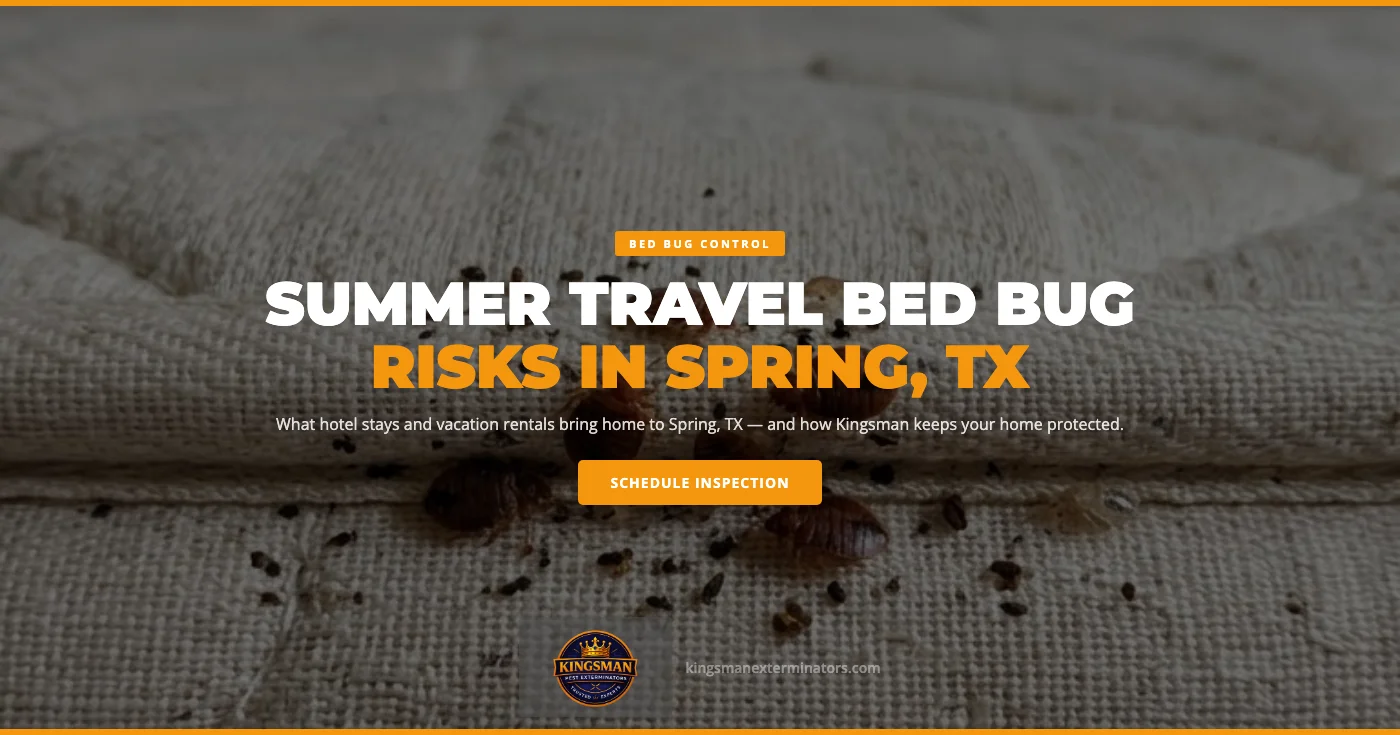
Every summer, the Memorial and Spring area sees a predictable uptick in bed bug calls — and the timing isn't a coincidence. Summer travel season means more hotel stays, more vacation rentals, and more people moving through properties that see hundreds of guests per year. Bed bugs don't travel independently; they rely on luggage, clothing, and belongings to move from place to place. Scheduling a professional bed bug inspection in Spring, TX after any extended stay is the most reliable way to confirm your home is clear before an infestation has time to establish.
At Kingsman Pest Exterminators, we provide professional bed bug control in Spring, TX and throughout the greater Houston area. Here's what every Spring-area family should know about summer bed bug exposure and what to do when you find signs at home.
Why Summer Is Peak Bed Bug Season in the Greater Houston Area
Bed bug activity doesn't have a true "season" in the way mosquitoes do — they're active year-round indoors. But summer is peak exposure season for two reasons: travel volume and heat.
Summer family vacations, July 4th weekend trips, and back-to-school travel in August all drive more residents through hotel properties, vacation rentals, and extended-stay accommodations. Each stay is an exposure opportunity. The more properties you move through in a season, the higher the cumulative risk of encountering an active infestation and inadvertently transporting bed bugs home.
Heat accelerates bed bug development. At 80°F — the approximate temperature inside a hotel room — bed bugs can develop from egg to adult in 21 to 28 days. This faster development timeline allows populations in heavily trafficked properties to build more quickly between professional treatments. In summer conditions, an infestation that was small in June can be significantly larger by August.
Texas summer heat is also relevant when the reverse scenario occurs: bed bugs transported home can establish themselves in a Spring residence more quickly in summer heat than in winter months. An inadvertently introduced population that might take months to become noticeable in winter can become evident within weeks in summer conditions.
How Bed Bugs Hitch Rides From Hotels and Vacation Rentals
Bed bugs enter luggage, bags, and clothing through several routes — and not all of them are obvious. Understanding the actual mechanics of bed bug transfer helps travelers make specific behavioral choices that reduce risk rather than relying on general caution.
Luggage placed on upholstered surfaces — particularly on beds, on luggage racks with fabric webbing, or on upholstered chairs near the bed — is the most direct exposure route. Bed bugs that have established harborage in the mattress, headboard, or nearby furniture will investigate warm objects in close proximity. Luggage left open provides easy access; luggage in contact with infested fabric allows direct transfer of hitchhiking individuals.
Clothing left on the bed, floor, or upholstered surfaces provides similar transfer opportunities. Even a few minutes of contact between clean clothing and an infested mattress can be sufficient for bed bugs to move onto the fabric.
Hard-sided luggage stored in closets away from sleeping areas is significantly less vulnerable than soft-sided luggage on or near the bed. A simple change in luggage storage habits — hard case on a luggage rack away from the bed, away from the wall, or stored in the bathroom on the tile floor — meaningfully reduces transfer risk.
Vacation rentals present additional variables. Cleaning protocols between guests vary widely, and the turnover between guests in a popular rental may not allow adequate time for thorough inspection and treatment if a previous guest introduced bed bugs. Rental platforms may not disclose bed bug history, and reviews don't reliably surface past infestations that were quietly addressed.
What to Check Before and After Every Summer Stay
A pre-stay inspection takes about five minutes and dramatically reduces the likelihood of an undetected infestation going unnoticed until you're home.
When you arrive at any hotel or vacation rental before unpacking: place luggage in the bathroom or entryway away from sleeping areas. Pull back the bedding and inspect mattress seams, particularly at the corners and edges. Look for small rust-colored stains, tiny dark spots, shed exoskeletons, and live insects. Pull the mattress slightly away from the headboard and inspect the gap. Check the headboard — behind it and in any decorative tufting — using your phone flashlight. Inspect nearby nightstands inside the drawers and in the joint where the back meets the wall.
If you find any evidence of bed bugs, request a different room — specifically one not adjacent to or directly above or below the original. The same applies if you have any suspicion about the cleanliness of the property.
After returning home: unpack outside or in the garage rather than in the bedroom. Launder all clothing — worn or not — on the hottest wash and dry cycle the fabric tolerates. Heat kills bed bugs at all life stages; clothes dryers set to high heat for 30 minutes eliminate any introduced individuals. Inspect luggage carefully before storing it, and consider storing luggage in a sealed plastic bag between trips.
Early Warning Signs of a Bed Bug Problem at Home
The earlier a bed bug infestation is caught in Spring, TX, the smaller and less complicated the treatment required. Knowing the specific evidence to look for — rather than simply "watching for bugs" — is the most practical early detection approach.
Blood stains on sheets and pillowcases — small rust-colored spots from crushed bugs or minor bleeding at bite sites — are often the first physical evidence homeowners notice. Check the area around where you sleep regularly during and after travel season.
Unexplained bites on exposed skin — particularly the arms, shoulders, and neck — appearing after sleeping warrant further investigation of the sleeping environment. Not everyone reacts to bed bug bites, but those who do typically notice bite clusters or lines that appear overnight.
Fecal spotting — tiny dark spots about the size of a pen tip that bleed into fabric — found in mattress seams, along the headboard, or at baseboards near the bed indicates established bed bug activity in that location.
A musty, sweet odor that persists in the bedroom despite regular cleaning, particularly near the bed area, can indicate a larger population producing detectable pheromone levels.
Why DIY Treatment Rarely Solves a Real Infestation
Over-the-counter bed bug products are widely available, but professional pest control experience in Spring and Harris County consistently shows that DIY treatment attempts delay professional resolution while allowing the infestation to expand and become harder to treat.
The most significant issue is that repellent insecticides — contact sprays and foggers — scatter bed bugs from their primary harborage areas into walls, furniture, and adjacent rooms rather than eliminating them. After DIY treatment, an infestation may appear to be gone for several weeks while displaced bugs establish new harborage locations and the original population continues reproducing in areas the product didn't reach. By the time visible evidence returns, the infestation has spread significantly beyond its original location.
Bed bugs also develop resistance to pyrethroid insecticides — the active ingredient in most over-the-counter products. Populations in urban areas like the Houston metro have shown documented resistance to these products, meaning standard consumer products may have limited effectiveness even when applied correctly.
When to Call a Professional Bed Bug Inspector in Spring, TX
Schedule a professional bed bug inspection if you're finding blood stains, bite marks, or fecal spotting in sleeping areas; if you've returned from travel and want confirmation that no hitchhikers came home; if you've been notified by a hotel, airline, or landlord of a potential exposure; or if DIY treatment has failed to resolve visible evidence of activity.
Kingsman Pest Exterminators provides professional bed bug inspections and treatment in Spring, TX. Our treatment approach eliminates both the visible population and the harborage populations that DIY methods typically miss, addressing the infestation fully rather than temporarily reducing visible signs.
Contact us to learn more about our bed bug control services in Spring, TX and throughout the greater Houston area.